Guides
Same box, a different way to check: manual counting and RFID
What changes when a receiving or shipping check reads item-level RFID tags, and what still needs an operator's attention.
Open the carton, check the items, seal it again. That familiar sequence is the starting point for our manual-versus-RFID campaign. The second half asks what changes when the items already carry readable RFID tags.
RFID does not need a direct line of sight to each tag. With suitable tags, products, packaging, and reader setup, that can let a team check item identities while a carton stays closed. The useful question is where that approach removes handling from your own receiving or shipping process.
Start with the job the check must do
A manual inspection may answer several questions at once: how many units are present, which variants they are, and whether anything is visibly damaged. Reading RFID identities addresses part of that work. It does not inspect a cracked product, a stain, or the quality of the packing.
Choose a check where item identity and quantity are the main questions. Keep any visual inspection your process still needs.
For an order check, prepare the expected products and quantities. Map each item’s tag to its product in DropRFID so the scan can be reviewed against that expectation. Six observed tags are only useful if they represent the six items the order needs.
Test with the box you actually ship
Use a representative carton, with the usual products and packing materials. Confirm the contents manually, then scan it in the intended work area. Review whether the expected identities appear and whether nearby tagged stock enters the result.
Repeat with different pack arrangements and deliberate exceptions, such as a missing unit or a wrong variant. Include the time spent reviewing and resolving those exceptions when you compare the process with a manual check.
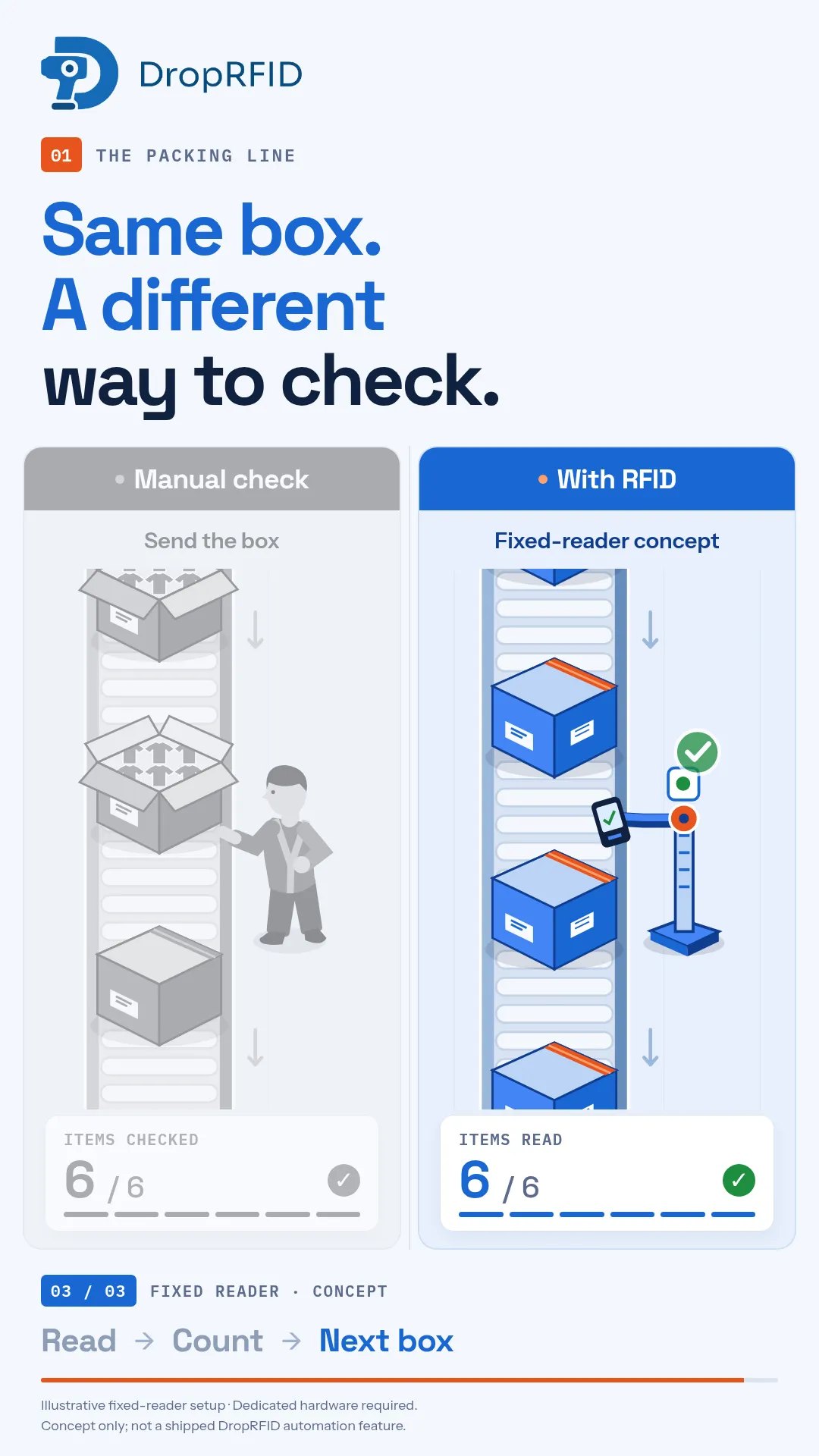
The campaign’s side-by-side timing and counts are illustrative. They are not a measured productivity result or a promise that any sealed carton can be read completely.
Choose the reader setup separately
The artwork includes a fixed-reader concept. That scene requires dedicated hardware and integration work; it is not a shipped DropRFID conveyor-automation feature. A handheld workflow is a separate setup that lets an operator direct the scan and review its result.
Begin with one repeatable check and measure it in your environment. Once the process works, you can decide whether a different reader arrangement is worth evaluating.
For the preparation step, read how supplier-tagged stock can simplify receiving. For the order context, see from Shopify order to verified shipment.