Field notes
A conceptual RFID checkout pattern for plate-based service
An independent observation and synthetic demo explore how tagged plates could connect a restaurant checkout flow to plate SKUs.
In a plate-based restaurant, the finished stack can carry useful information. An independent observation at Suiten Sushi in Beppu shows a staff member bringing a handheld reader close to a stack of plates, handing over a card, and completing the checkout at the cashier. The exact plate and card implementation was not independently verified.
This article is not evidence of a DropRFID integration, endorsement, or customer relationship. Suiten Sushi is not affiliated with, connected to, or endorsing DropRFID. Publication of any real-venue footage requires permission and careful review for faces, receipts, payment details, and other private information.
The design pattern
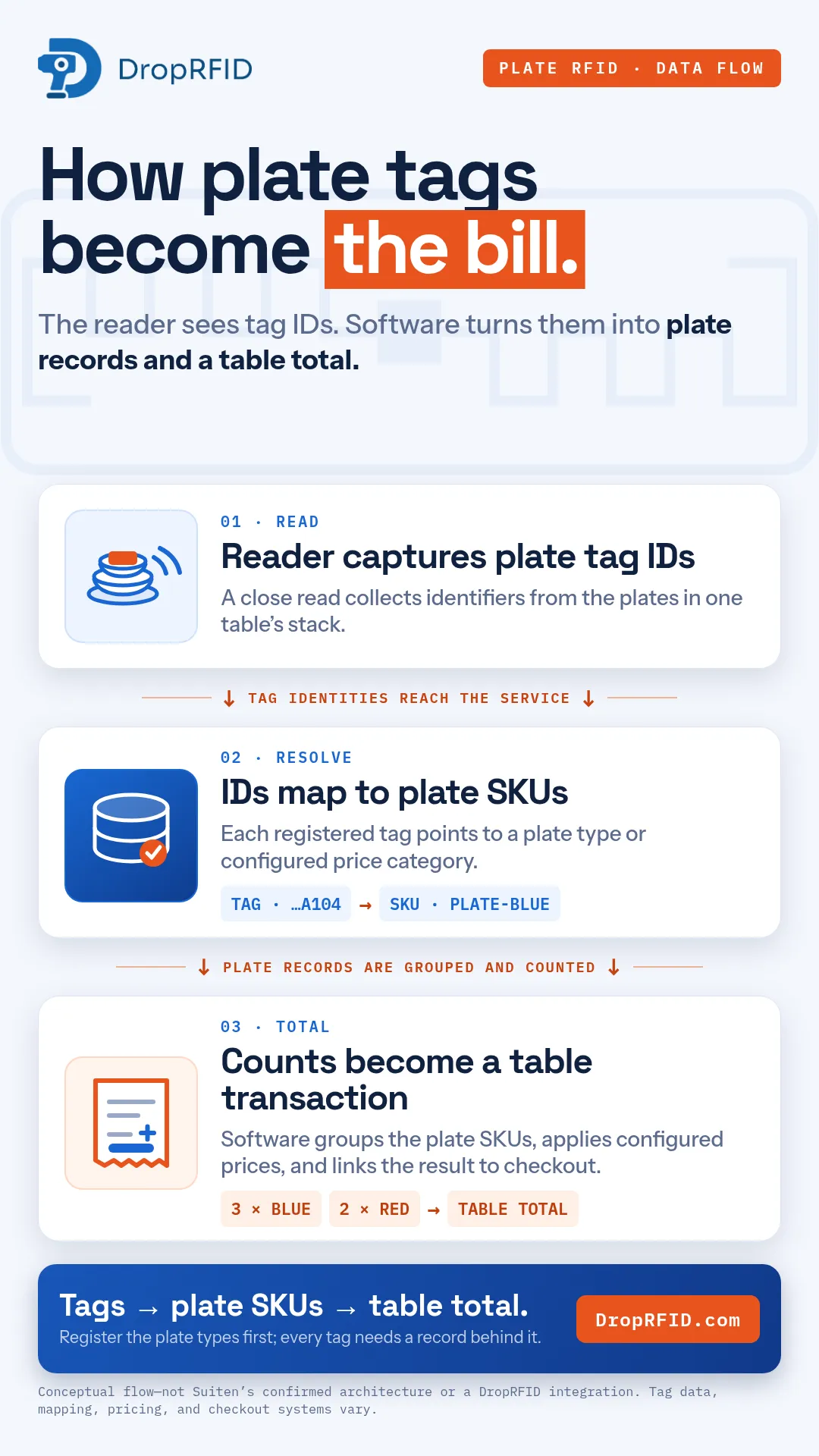
Conceptually, a tag attached to or associated with a plate can resolve to a plate SKU or price category. The reader captures observed tag IDs, and software maps those IDs to the expected product records. A staff member can then take a checkout card or other handoff artifact to the cashier.
That is a system pattern, not a claim that every plate has a unique EPC or that every restaurant’s card stores the bill. The tag, reader, mapping, cashier process, and payment system must be designed and tested together.
A synthetic DropRFID demo
The accompanying recording uses mock-backed data: three existing colored plate SKUs, a fourth sample “Golden Plate” SKU, and four sample RFID values. It demonstrates creating a SKU and linking tag IDs in the registry. The dollar values shown in the synthetic names are example data, not a restaurant price list or proof of a live integration.
DropRFID’s Try It plan is currently $29/month for one device. That price is a product-plan fact, not a projection of restaurant savings or checkout speed. The demo does not establish accuracy, payback, labor reduction, or a universal implementation time.
Questions to test in a real pilot
Before adopting a design, confirm where tags can be placed without affecting washing, stacking, food safety, or presentation. Test materials, reader position, tag orientation, expected volume, and the handoff to the cashier. Decide what happens when a tag is missing, a plate is replaced, or a read is ambiguous.
Protect customer and staff privacy throughout the test. Minimize retention of receipts, payment details, map history, and identifiable footage. Keep a manual fallback for service continuity.
The useful takeaway is modest: a physical object can carry an identity that software maps to an operational record. Whether that pattern fits a particular restaurant depends on the complete environment—not on the concept image alone.
The same pattern can be adapted to other service workflows, but adaptation is not automatic. Each venue should validate its own equipment, cleaning process, staffing model, register integration, and privacy requirements. A synthetic demo is a useful conversation aid; it is not a substitute for that venue-specific test.