Guides
Check whether RFID fits your operation
A practical starting point for exploring RFID: answer a few use-case questions or ask the DropRFID Assistant about fit, setup, and integrations.
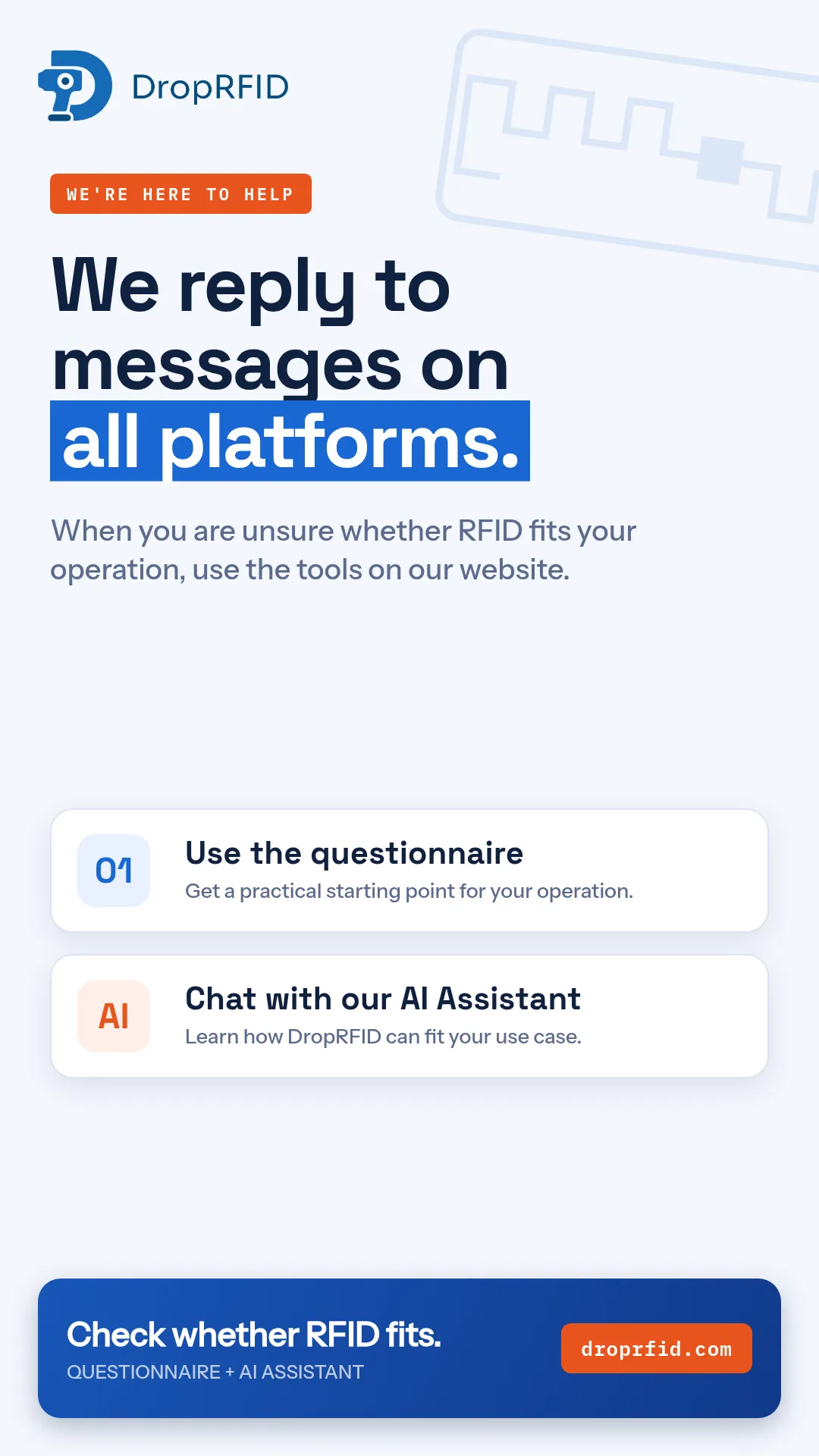
The first RFID question is often not “which tag should I buy?” It is “does RFID fit the work I am trying to improve?” DropRFID’s public website offers two ways to get oriented: a short questionnaire and the DropRFID Assistant.
Use the questionnaire as a starting point
The questionnaire asks what you track, roughly how many items you handle, where inventory lives today, and how many scanners your team expects to use. Its result is a practical starting point, not a complete implementation assessment or a commitment to a particular architecture.
Those questions matter because the right design depends on the objects, volume, surfaces, readers, workflow, and environment. Apparel and retail stock may lead to different testing than tools, equipment, documents, or records. A spreadsheet-based process may need a different first step than a Shopify or WMS workflow.
Treat the recommendation as a conversation starter. Validate tag placement and reader behavior with representative items before making a purchasing or rollout decision.
Ask the Assistant about the product
The DropRFID Assistant can explain product fit, setup, pricing, hardware, Shopify paths, webhooks, and API concepts. It provides general product guidance. It does not automatically access private organization data, private inventory, or account credentials.
Do not paste secrets or confidential customer information into a public assistant. For account-specific questions, use the appropriate secure support or account channel.
The assistant also should not be treated as an in-app inventory analyst. Current AI capabilities include Smart Import and the ability for customers to connect their own AI through APIs. Production anomaly detection, forecasting, and natural-language inventory querying inside DropRFID are not current shipped claims.
Keep the next step concrete
After the questionnaire or assistant conversation, write down one workflow to test: receiving a shipment, checking an order, counting a location, or linking tag IDs to SKUs. A small pilot should include the actual materials and operating conditions, because metal, liquids, orientation, interference, and reader settings can affect results.
The public-site campaign artwork shows example screens and sample conversation states. It is not a customer account or a promise that every operation will receive the same plan recommendation. Use it to begin the fit conversation, then validate the workflow with real requirements.
Start at DropRFID.com and bring a specific question.
If the use case is still broad, begin with the physical objects and the decision the team needs to make. “Which units are here?” “Does this order match?” and “Which record should this tag identify?” are more useful pilot questions than a generic request for automation. They create a test that can be observed and improved.
The resulting notes can also make a later conversation more efficient: list the items, surfaces, expected volume, current source of truth, and the exception that matters most.