Guides
NFC vs. UHF RFID: the family map and its trade-offs
A practical map of LF, HF/NFC, and UHF/RAIN RFID, including range, speed, materials, power, and total-system trade-offs.
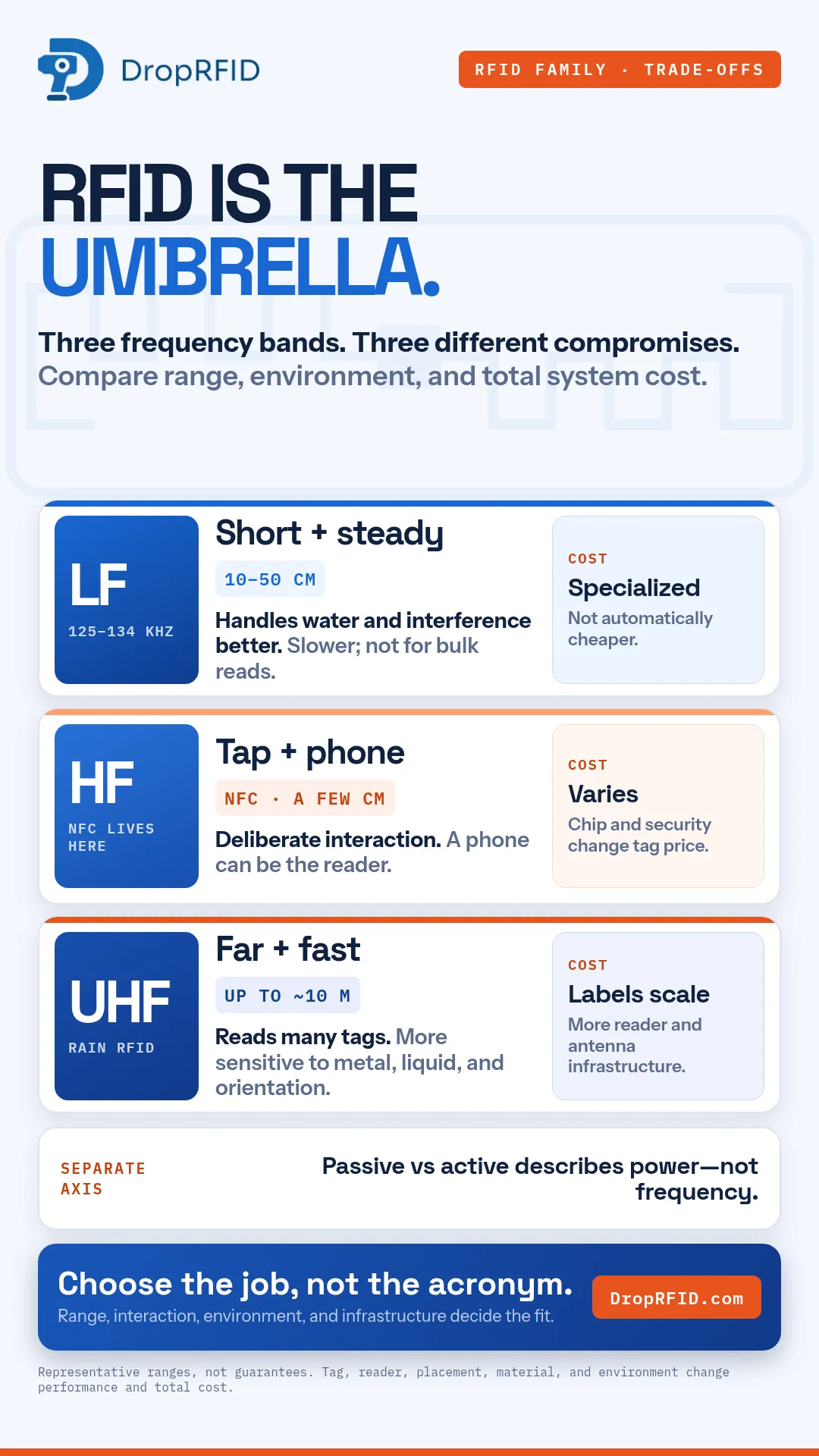
RFID is an umbrella, not a single performance profile. NFC and UHF RFID sit in the same broad family, but they solve different interaction problems. A useful comparison starts with frequency branch, then separates that from how the tag is powered.
Three common branches
Low-frequency (LF) systems are short-range and comparatively tolerant of some interference and water-heavy environments. They are specialized, not automatically cheaper.
High-frequency (HF) systems support close, intentional interactions. NFC is an HF technology designed around a phone-friendly tap, often within a few centimetres.
Ultra-high-frequency (UHF), commonly called RAIN RFID in passive deployments, reaches farther and can identify many tags quickly with a dedicated reader. It is a common fit for inventory, receiving, and order verification.
These are design tendencies rather than promises. Read range and speed depend on the tag, antenna, reader, placement, surface, orientation, environment, and interference.
Frequency is not the power source
Passive, battery-assisted, and active describe how a tag is powered. They are not extra frequency branches. A passive UHF label and a powered location tag may use different system architectures even when a project loosely calls both “RFID.” Specify the frequency, tag power, reader, and desired behavior separately.
The same separation helps with price. Frequency alone does not determine total cost. Include tags, readers, antennas, mounting, integration, calibration, testing, and the environment where the system must work. Passive labels can be economical at volume, while reader infrastructure and difficult materials can require more engineering.
Tap one or count many?
NFC is a natural choice when a person should deliberately tap a nearby object. UHF RFID is a natural candidate when an operation needs to identify multiple tagged items without optical line of sight. Some designs use both: NFC for customer interaction and UHF for back-of-house work.
Neither branch is automatically a location system. UHF can identify a tag in a configured read zone, but it does not inherently provide exact coordinates. If the requirement is proximity, zones, direction finding, or precise indoor ranging, compare BLE, UWB, and vision as complete systems, including their privacy and infrastructure trade-offs.
A better selection process
Write down the job first: identify, detect, or locate. Then test the representative product, surface, tag placement, and reader position at realistic volume. Record what is observed rather than borrowing a headline range from a different installation.
The family-map artwork is an educational explainer, not a product benchmark. It is intended to make the trade-offs visible without implying a universal winner. A careful pilot will tell you more than a frequency label alone.
Document the test conditions alongside the result: product material, tag location, reader and antenna position, number of items, and surrounding equipment. That record makes it easier to compare options honestly and to explain why a result from one environment may not transfer to another.