Guides
NFC vs. RFID: start with the interaction
NFC is part of the RFID family. Compare a deliberate tap with passive UHF RFID for distance, scale, and inventory work.
NFC and RFID are often framed as competing technologies. That framing makes the decision harder than it needs to be: NFC is one part of the broader RFID family, while passive UHF RFID is another branch with a different interaction model.
NFC is a deliberate tap
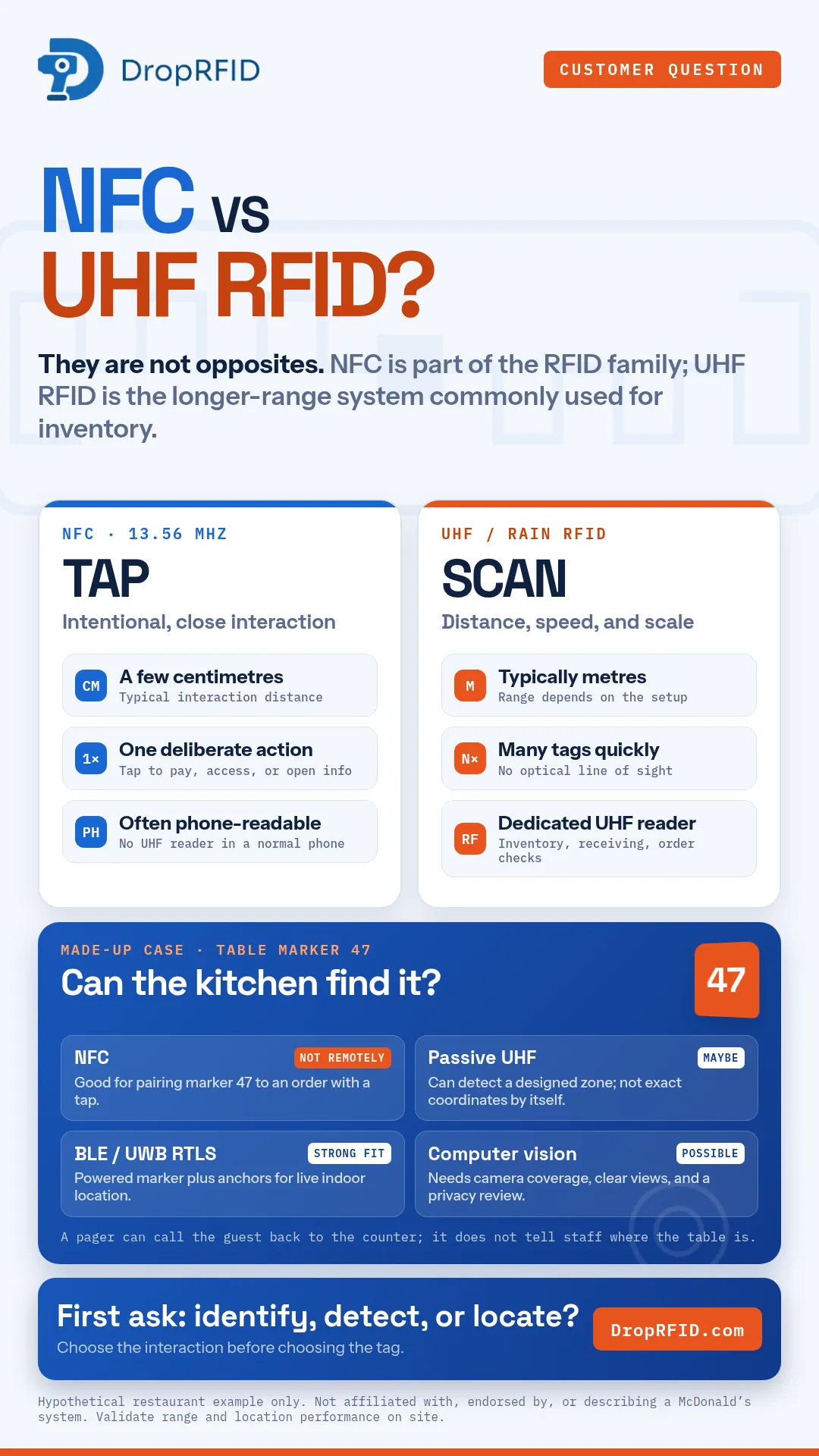
NFC is designed for a close, intentional interaction, usually within a few centimetres. A person brings a phone or compatible reader to one tag at a time. That makes NFC a natural fit for payments, access, pairing, and opening product information.
The important word is deliberate. NFC is useful when the person should choose the moment of interaction and the object is nearby. It is not a general-purpose way to locate an item across a room.
UHF RFID is built for distance and scale
Passive UHF RFID, also called RAIN RFID, uses a dedicated reader to identify tagged items from a greater distance and without optical line of sight. It can support inventory counts, receiving, order verification, and configured read zones where many tags need to be detected.
Actual performance depends on the tag, placement, material, reader settings, environment, and interference. Treat “several metres” and bulk-read speed as qualified design considerations, not guarantees. A pilot in the real space is the right way to validate a workflow.
Choose the job, not the acronym
If the interaction is “tap one item,” NFC may be the better fit. If the job is “count many tagged items,” passive UHF RFID may be more appropriate. Some products can use both: NFC for a customer-facing tap and UHF RFID for an operational count.
Neither technology automatically provides live location. A UHF read can confirm that a tag was detected in a designed zone; it does not, by itself, produce exact X/Y coordinates. If the requirement is room-level or precise indoor location, evaluate a location system such as BLE or UWB, with its own infrastructure, calibration, battery, privacy, and cost trade-offs.
A useful decision checklist
Start by documenting the required distance, number of tags, reader type, environment, precision, and privacy expectations. Then test representative materials and orientations. Metal, liquids, curves, and close tag spacing can all change the result.
The campaign image paired with this article is an educational comparison, not a customer deployment. Its restaurant example is fictional and is not affiliated with or endorsed by any named restaurant. The same principle applies to any concept demo: use it to clarify the design question, not as evidence that a particular venue has adopted the system.
When the goal is clear, the technology choice becomes clearer too: identify, detect, or locate. Start with that interaction.
That framing also helps teams communicate internally. A customer experience may need a phone-friendly tap, while an operations team needs a repeatable count. Naming those as separate jobs avoids forcing one tag or reader to solve every problem.