Guides
Count the shipment before the deadline
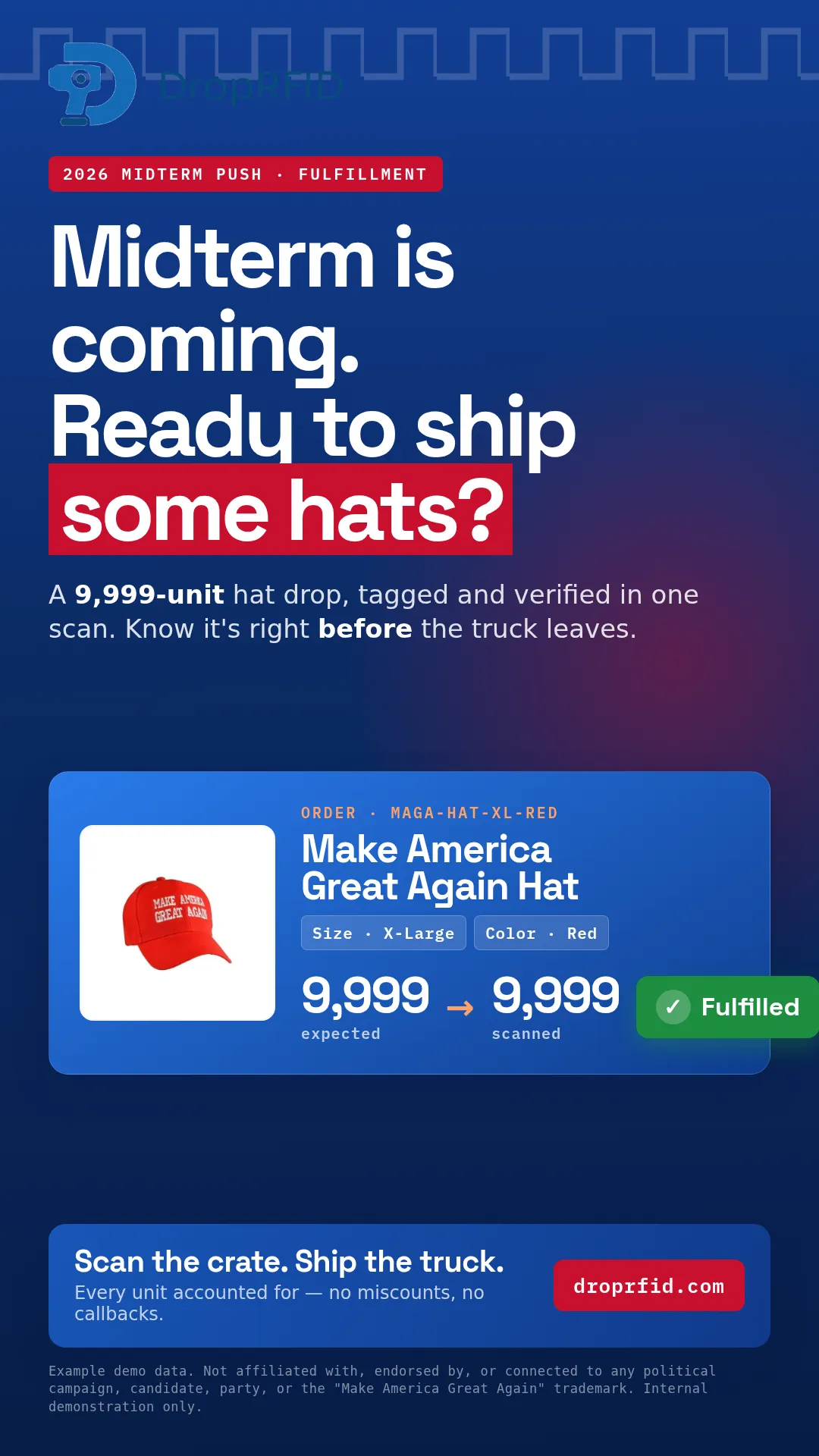
An illustrative high-volume hat-order workflow showing Shopify import, SKU mapping, RFID scanning, and expected-versus-observed review.
Large quantities make a simple question feel urgent: did the shipment contain the expected amount? A count on a screen is only useful when it is tied to an order, SKU, and defined scan process.
The sample flow
The campaign uses a fictional hat order and a displayed quantity of 9,999. That number, order ID, product name, EPCs, and completion state are example demo data. They are not a customer shipment, political affiliation, campaign endorsement, or measured result.
The workflow imports the order from Shopify, maps the hat to a SKU, and creates an expected quantity. The operator then reads the RFID-tagged goods, while the scan view shows progress toward the expected total.
Why expected quantity matters
The scan should answer “how many expected units have responded?” rather than simply counting every radio response. Product identity and quantity let the workflow distinguish matched items from missing or unexpected ones.
At high volume, teams should test the reader, tag placement, container geometry, orientation, interference, and read zone. A large displayed count is not evidence that every physical unit will read in every environment.
Keep integration claims precise
Shopify order import is a supported path. Inventory or fulfillment write-back is configuration-dependent and should not be assumed from the demo. If a downstream system needs completion notification, a signed webhook can be configured after the session completes; it is not the synchronous controller of the scan.
The public-safety line
The source campaign references a political trademark and a midterm theme. It is illustrative and not affiliated with, endorsed by, or connected to any political campaign, candidate, party, or trademark owner. For public product education, replace the branded merchandise with neutral sample inventory.
The operational lesson remains useful: import the expected order, map the SKU, scan the handling unit in a tested zone, and review exceptions before release. Explore the DropRFID overview and RFID docs.
At very high quantities, the sample should be designed around the physical process rather than the headline number. Test representative cartons or handling units, decide how duplicate reads are treated, and record what an operator does when a unit is unexpected. A large order can be broken into controlled checkpoints without changing the underlying expected-versus-observed model.
The final completion state is therefore a workflow checkpoint, not a guarantee. It tells the team what the configured session observed and gives them a basis for releasing, holding, or investigating the shipment.
That distinction keeps the demonstration useful: it teaches a repeatable control point while leaving performance claims to a documented test.
The same review pattern works for ordinary seasonal inventory without the campaign framing.