Field notes
When one jersey SKU gives way to the next
An illustrative sports-merchandise workflow about retiring one SKU, onboarding another, and verifying tagged inventory before fulfillment.
Product catalogs change. A retiring jersey SKU can overlap with the next one, and a fulfillment team still needs to know which tagged goods belong to which order line.
The baton is a catalog handoff
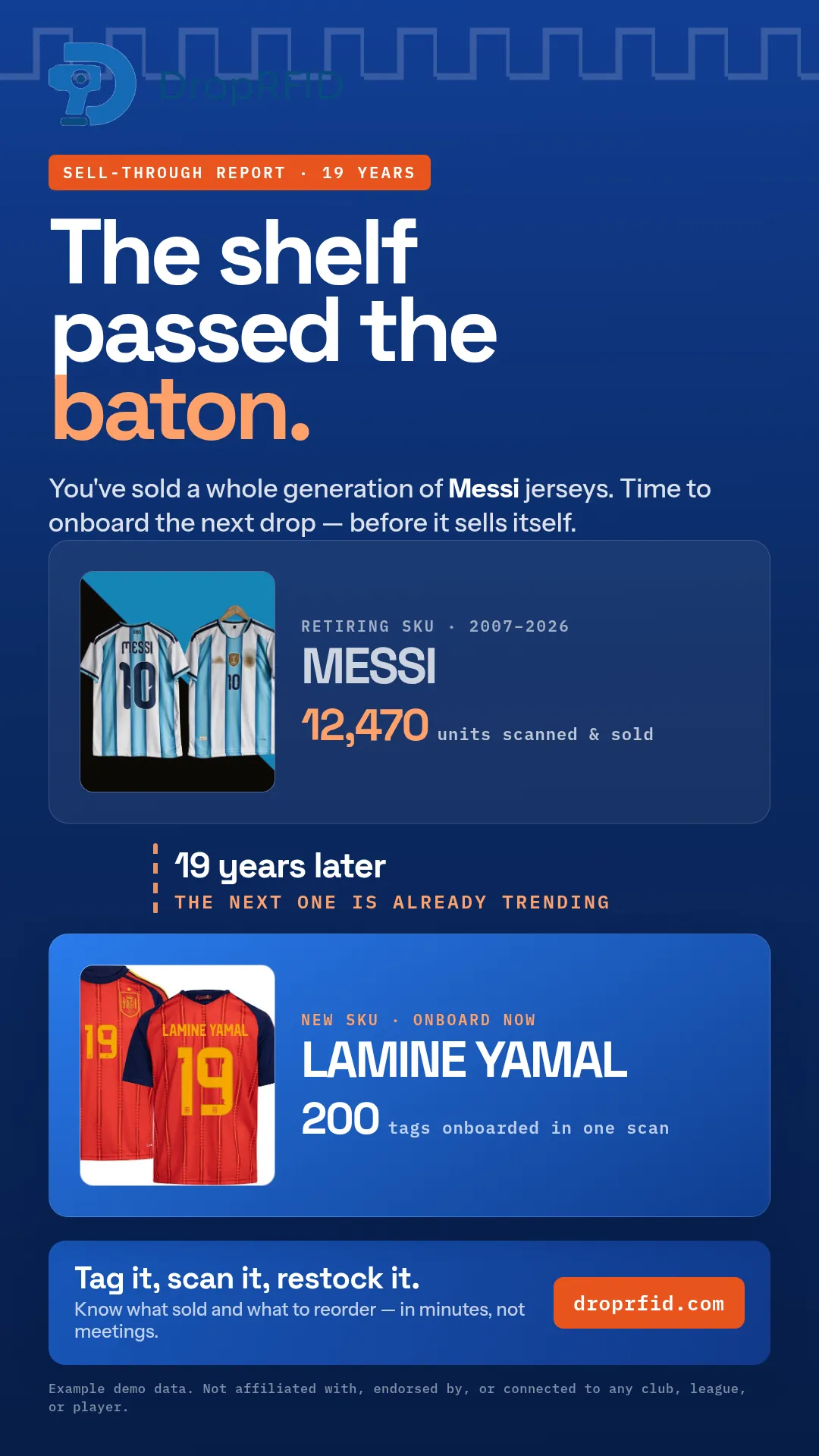
The campaign’s “pass the baton” idea is a visual metaphor for SKU lifecycle management. One jersey record recedes while the next becomes active. The supplied images, names, and order scenario are illustrative demo material and do not represent a real sale, customer, player, team, league, or endorsement.
The operational pattern is straightforward: create or maintain the new SKU, map its RFID identities, create an expected order, and scan the goods before fulfillment. Keeping the records distinct helps prevent a visually similar successor product from being treated as the same item.
Expected versus observed
An order supplies expected products and quantities. A scan session supplies observed tag identities. The comparison can surface a matched item, a missing line, or an unexpected identity for review. That is more useful than treating every read as an unqualified success.
The campaign’s counts and jersey labels are example demo data, not measured sell-through, inventory, or fulfillment results. RFID does not prove authenticity or team affiliation; it supports identity mapping when tags and records are configured correctly.
Use generic creative for public work
Because this concept involves real celebrity and team references, it is not a public endorsement. It is not affiliated with, endorsed by, or connected to the named people, clubs, leagues, retailers, or venues. A public product tutorial should use generic product names and approved imagery, with the same SKU-and-scan mechanics.
A repeatable handoff checklist
Confirm the old and new SKU codes. Map the correct tag identities. Define what happens to leftover inventory. Import the order from a connected Shopify store when configured. Scan in a controlled zone, review exceptions, and only then continue to fulfillment.
That checklist is the useful part of the metaphor: a catalog transition is easier to operate when the identity change is explicit. See the SKU and order docs for the current product workflow.
For a real assortment, the same method applies beyond jerseys. Separate product families, variants, and seasons in the catalog; define which identities may be scanned against each order; and give the operator a review path when a visually similar item appears.
Use the metaphor as a teaching device, then replace the fictional names and quantities with approved sample data. Keep the rights review separate from the technical review so a useful workflow explanation does not accidentally read like a celebrity endorsement.
The product system should remain the source of truth for the catalog and order; the creative framing is only a way to make the transition easy to remember. That distinction prevents a campaign concept from being mistaken for evidence about a real athlete or organization.