Field notes
Barcode in, reusable hanger out
An illustrative laundry workflow using a temporary barcode-to-hanger association and RFID pickup verification.
This is a made-up laundry case study. It describes a plausible integration pattern, not a real DropRFID laundry customer, deployment, or measured outcome.
Establish the relationship once
At intake, staff creates or opens a laundry order and scans a printed barcode on a reusable hanger. The barcode establishes the garment or job context. The hanger also carries a serialized RFID identity, which can be linked to that record.
The tag stays on the hanger—not the clothes. If a garment moves to another hanger, the association must be updated. Customer names, phone numbers, payment details, and other personal data belong in the protected business system, not in clear text on the tag.
Verify the pickup group
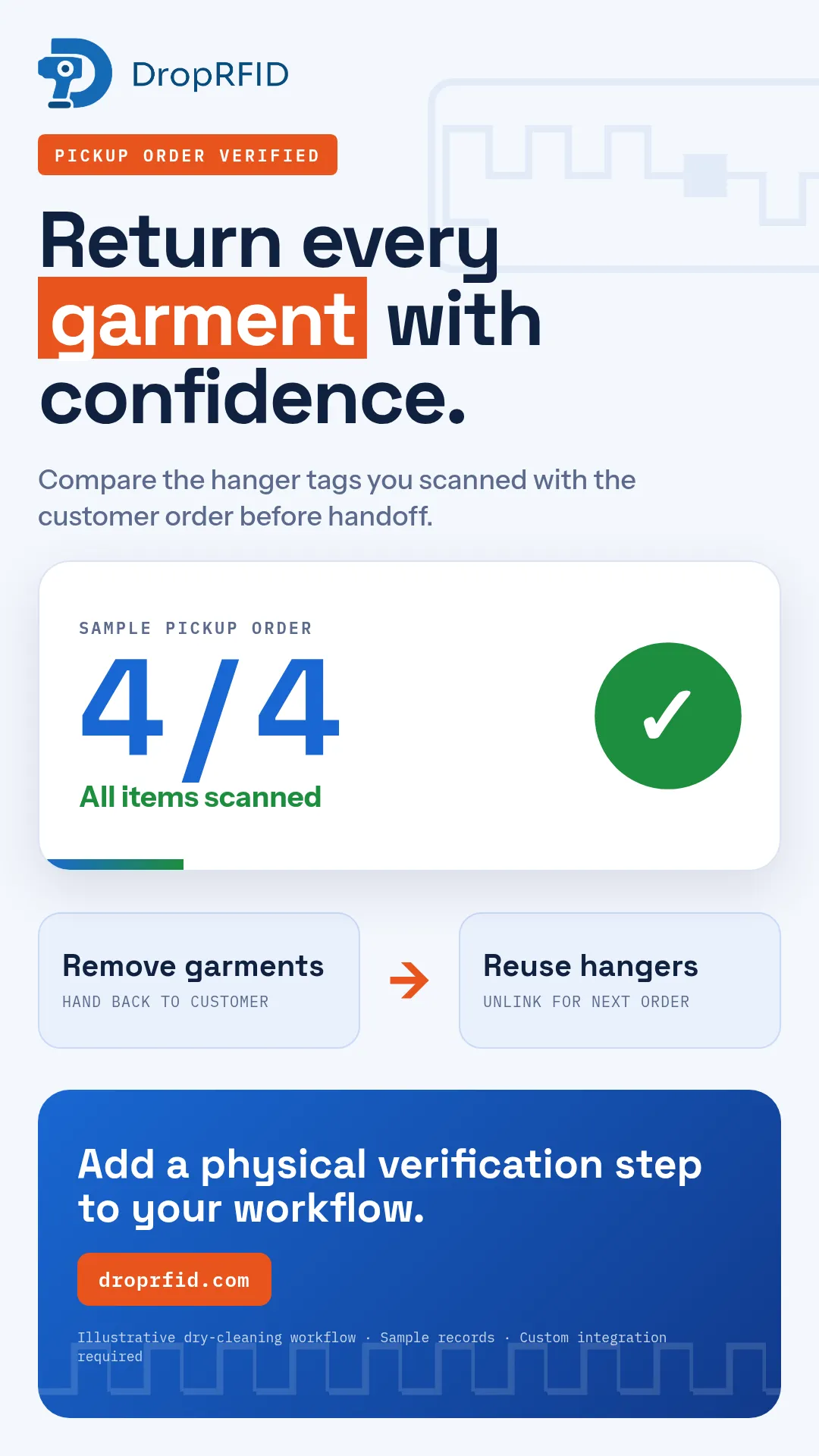
After cleaning, the finished garments remain on their associated hangers. At pickup, staff reads the hanger identities in a controlled zone and compares the observed group with the expected order. A sample session might show four expected, four matched, and zero missing, but that is illustrative data—not a guarantee of perfect matching.
The result says which expected hanger identities responded. It does not prove cleanliness, ownership, garment condition, stain removal, or correct pricing. Those remain operational and business-system responsibilities.
Build the custom layer explicitly
DropRFID’s SKU registry, order creation, RFID session capture, and expected-versus-observed comparison are relevant building blocks. The temporary garment-to-hanger relationship, laundry POS integration, read-zone design, and hanger reuse lifecycle would need a designed custom integration; they are not presented as an out-of-the-box laundry module.
Webhooks can notify or reconcile a downstream system after a completed session. They should not be the synchronous controller of a pickup decision. The immediate verification screen should use the application and configured comparison path directly.
Test the physical environment
Garment density, hanger material, metal rails, tag orientation, reader power, and interference can all affect results. Keep a printed barcode fallback for exceptions, define how hangers are unlinked after pickup, and retain only the records required by the business’s policies.
The source footage, clothing images, hanger IDs, order, and scan results are fictional or illustrative. No real laundry, customer result, venue, or affiliated business is shown. Use the documentation to explore the general order and scan model.
The temporary association is what makes the concept operationally different from simply tagging every garment. It gives the business a clear moment to create the link, a clear moment to verify the group, and a clear moment to remove the customer context.
An operator should also be able to explain a mismatch: was a hanger missing, was the wrong hanger attached, did a nearby group respond, or did the record need updating? A good exception screen supports that investigation without turning a sample “matched” count into a guarantee.