Field notes
A better RFID question for self-service bag drop
An illustrative airport thought experiment about checking an expected baggage tag inside a contained bag-drop zone.
This is a MADE-UP CASE STUDY: an imaginary workflow inspired by an observation at a self-service baggage drop. It is not a claim that the pictured airport, airline, machine, or venue uses DropRFID or RFID in the proposed way.
Narrow the problem
“Track luggage everywhere” is a broad systems problem spanning airlines, airports, handlers, and handoffs. A self-service bag-drop enclosure is a narrower question: while one passenger session is active and one suitcase is inside a defined zone, did the system observe the expected baggage-tag identity?
The proposed workflow is illustrative. Normal weight, dimensions, barcode or human-readable fallback, airline rules, and staff exception handling still matter.
A possible checkpoint
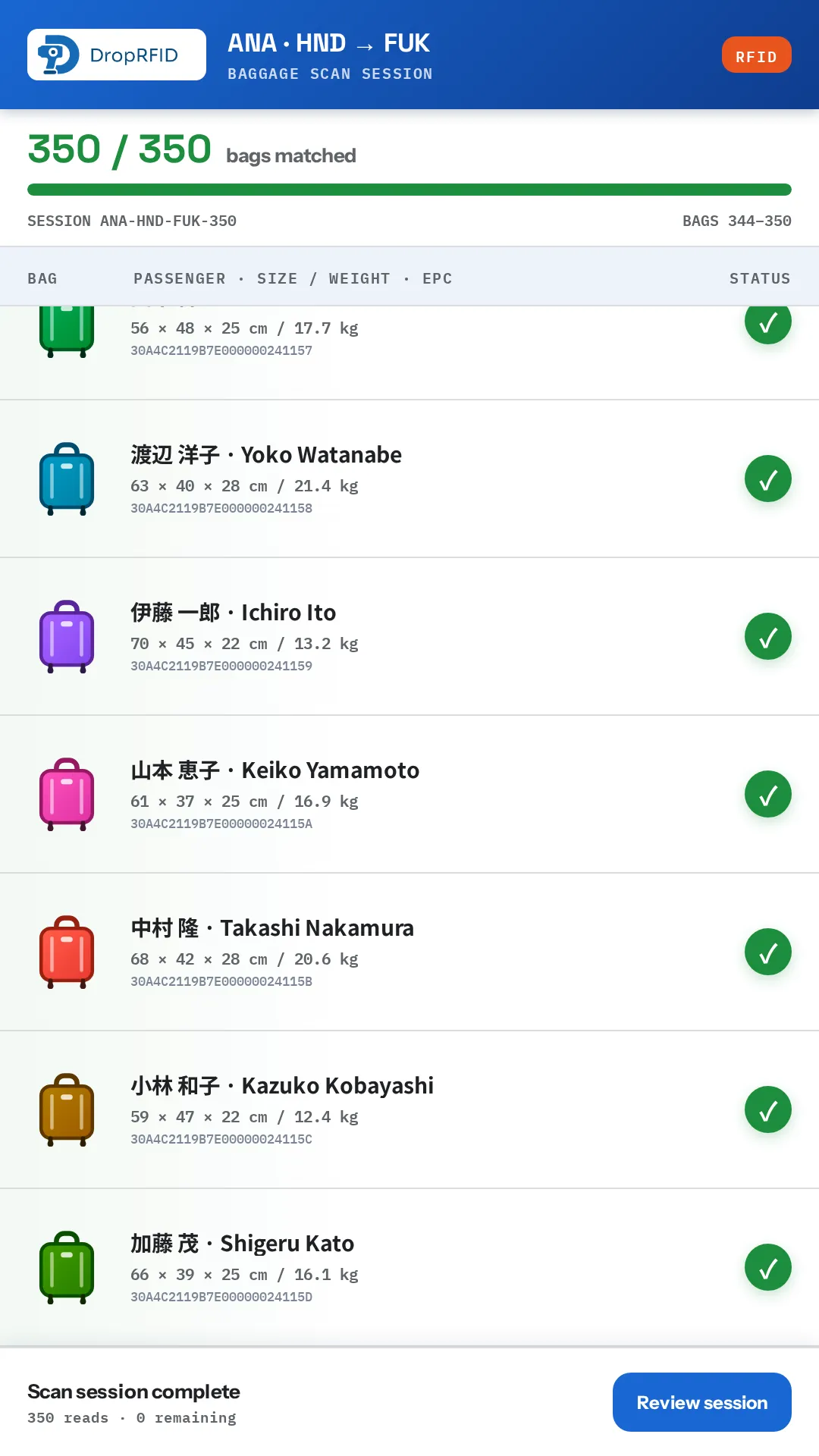
The passenger checks in and receives a printed baggage tag. The airline system associates that tag identifier with the active bag-drop session. The passenger places one bag in the enclosure. A configured reader observes the tag inside the read zone, and the controller compares expected with observed.
The immediate result could be accept, stop, or review. A missing, unexpected, or ambiguous read should produce a correction path or staff intervention—not an automatic assumption that the bag is correct.
API and webhook have different jobs
The acceptance decision must happen in the controller or a purpose-built request/response integration while the bag is still present. It must not wait for an asynchronous webhook.
After the completed check is recorded, a signed session.completed webhook can notify a downstream system. Delivery may be retried, so the receiver should deduplicate events. The airport-specific endpoint shown in the source concept is fictional; it is not a published DropRFID public endpoint.
What this does not claim
The source includes a real venue observation, but the RFID design, endpoint, data, and outcomes are invented. No airport, airline, baggage handler, or technology partner is affiliated with or endorsed by this concept. It does not claim that RFID alone proves custody, destination, passenger identity, or successful delivery.
Any real deployment would require tested tag placement, reader geometry, interference testing, safety review, privacy controls, and integration with the operator’s systems. The lesson is to choose a contained decision point and define the exception path before selecting hardware.
The contained zone is the key design choice. A reader that is useful inside a bag-drop enclosure may not be appropriate on an open belt or in a baggage hall where neighboring tags can respond. Read duration, antenna placement, shielding, and the operator’s normal process would all need validation.
The same principle applies to the data contract. Define the expected tag, observed tags, decision, and event identifier; then document what happens when the result is ambiguous.
That boundary-first approach keeps the thought experiment honest. It also gives an engineering team a concrete starting point for testing without implying that a generic public API can ingest RFID reads or complete an airport bag-drop session today.