Field notes
Tag the habitat box, not the beetle
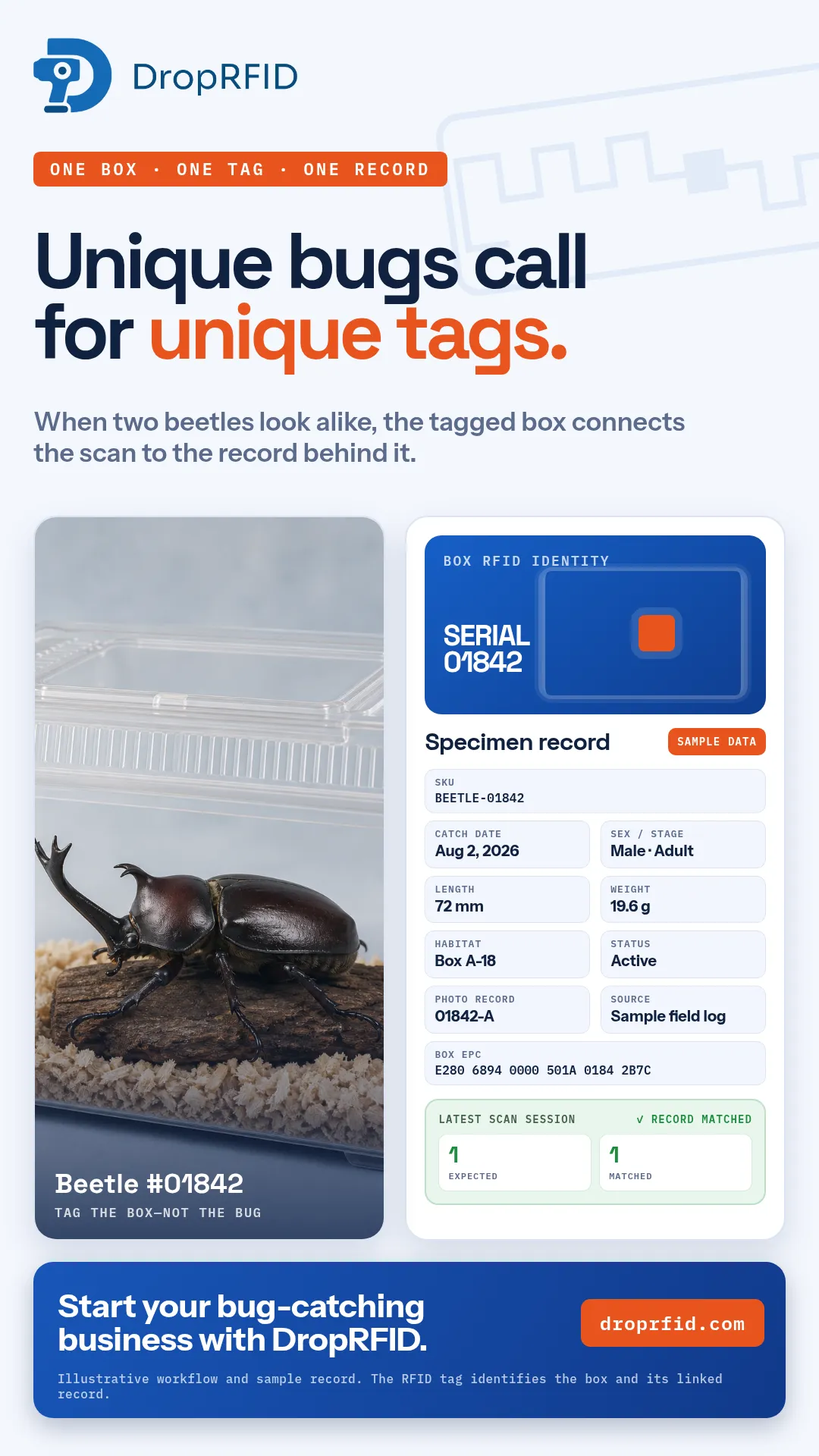
An illustrative insect-shop workflow showing how a serialized box identity can connect a sample record to a SKU without claiming biological identification.
How do you distinguish two similar-looking insects in a collection workflow? One practical design question is where the identity belongs. In this made-up case, it belongs to the habitat box and its linked record—not to the beetle.
One box, one tag, one linked record
The campaign creates a sample SKU such as BEETLE-01842, links one serialized RFID identity to a habitat box, and shows a record with example fields such as catch date, weight, length, habitat location, and a reference image.
Those values are fictional sample data. The scan screen is a product demonstration, not a real insect shop deployment, customer result, or biological identification system.
When the box is scanned, the operator can open the associated record and perform a visual check. That is a useful identity pattern: a tag points to a managed record that contains context the business chooses to maintain.
Why the tag should stay on the box
Tagging the box avoids presenting the RFID label as an animal identifier. If the beetle moves to another habitat, the association must be updated. Otherwise the system may correctly read the box while showing stale context.
The same principle applies to products, totes, tools, and reusable carriers: tag the durable operational object, then maintain the relationship between that object and the record behind it.
What RFID does not prove
An RFID identity does not prove species, sex, health, genetics, origin, ownership, welfare, or legal status. A product image is a reference aid, not automated taxonomy. Any care, compliance, or provenance process needs its own evidence and controls.
The fictional shop, footage, SKU, EPC, measurements, and records are not affiliated with or endorsed by the venue or business shown in the source media. The workflow is illustrative only.
A sensible implementation question
Start by defining the relationship: which box is linked to which record, when is that link created, and how is it changed? Then test tag placement, reader behavior, exception handling, and privacy in the actual environment. DropRFID’s SKU registry, RFID mapping, and scan review provide building blocks; a specialized insect-care or taxonomy module is not implied.
Use the docs to explore the underlying SKU and scan concepts, and label all demo values as sample data.
The record can remain useful without becoming a claim about the animal. A business might store its own care notes or internal sample reference, but those fields should be clearly owned by the operator and reviewed for accuracy. The RFID identity is simply the key that helps retrieve the record associated with the box.
That separation is a useful design pattern for any regulated or sensitive inventory: keep the physical identifier simple, keep descriptive context in the appropriate system, and define who may edit the relationship when an item moves.