Field notes
Import, verify, and fulfill a high-attention order
An illustrative sports-merchandise workflow for connecting Shopify orders, SKU identity, and RFID scan review before fulfillment.
When a product moment creates a rush of demand, fulfillment teams still need the same basics: an expected order, clear SKU identity, and a way to review what was physically read before shipping.
The workflow behind the headline
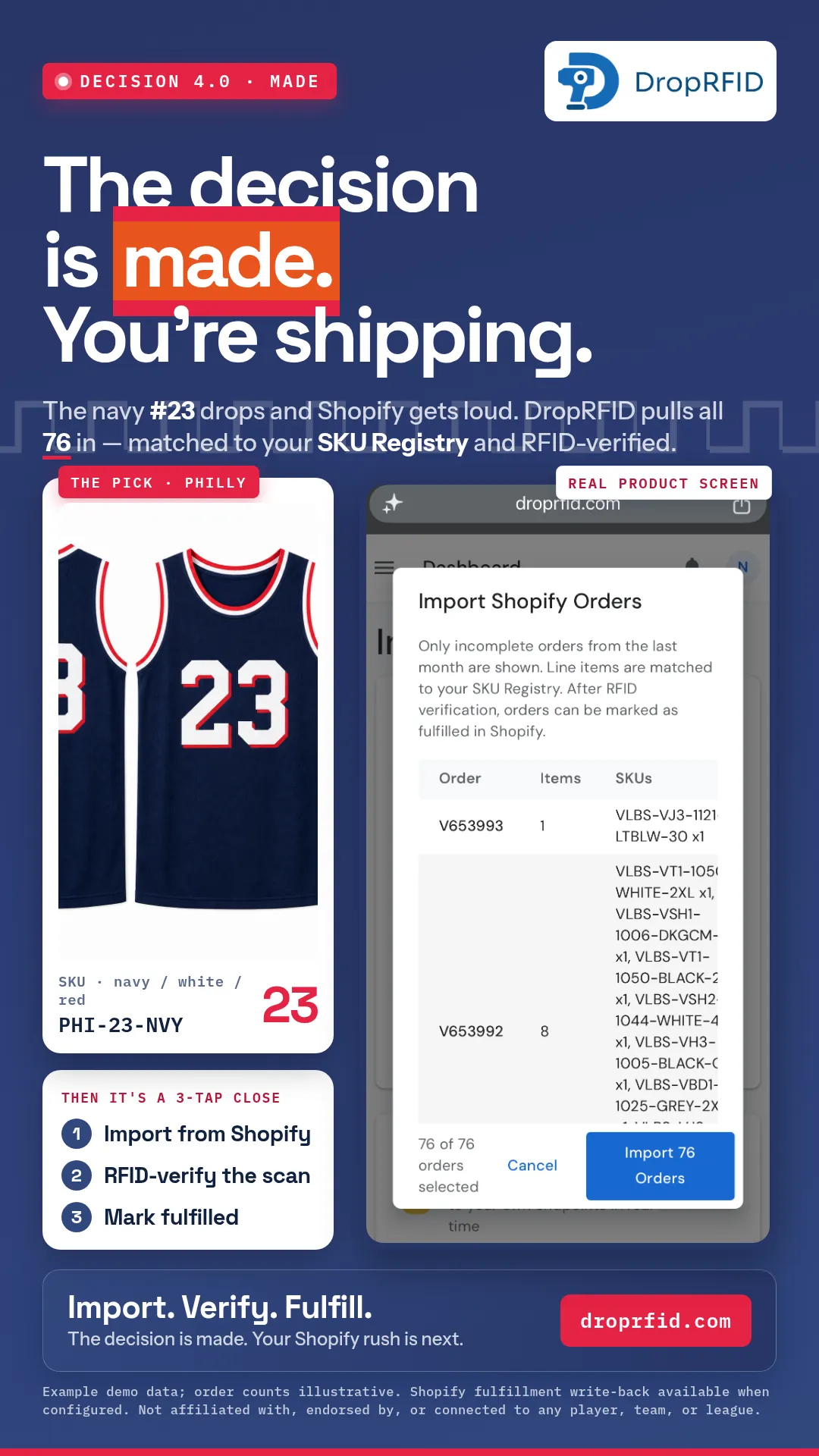
The supplied campaign uses a fictional order and a navy number-23 jersey SKU. It demonstrates a sequence rather than a real sale: import a Shopify order, match its line to the SKU Registry, scan the tagged item, and review the completed state.
That sequence is reusable across many categories. The attention-grabbing product can change; the control loop remains expected versus observed.
Shopify first, scan second
An imported order establishes what the team expects to fulfill. The SKU Registry adds the product context needed to interpret tag reads. During scanning, the operator can see whether the expected identity has been matched and whether anything remains missing.
The campaign’s order number, count, jersey name, and result are illustrative demo data. They do not establish a real player, team, league, customer, or sales outcome.
Keep fulfillment claims conditional
Shopify inventory or fulfillment write-back is configuration-dependent. A connected workflow may support it when set up, but importing an order and reviewing a scan does not automatically write back to every Shopify account.
Likewise, an RFID match is evidence that a responding identity resolved to the expected record. It is not proof of authenticity, ownership, or a guaranteed perfect count.
Rights and affiliation matter
This campaign includes a real celebrity name and sports imagery. It is illustrative and not affiliated with, endorsed by, or connected to the named player, any team, league, retailer, or venue. It should not be treated as a public endorsement or a customer case study without appropriate permissions.
For a publishable workflow demo, use generic product names and synthetic records. Then test the same operational questions: Can the order be imported? Are tags mapped to the right SKU? Can exceptions be seen before fulfillment?
Explore the DropRFID overview and RFID workflow documentation for the current product surface.
The handoff also needs a cutoff. Decide when the old SKU stops being accepted, who can correct a mistaken mapping, and what happens when a returned item still carries the previous identity. Those decisions are ordinary catalog governance, but they become especially important when a trend compresses the time available for review.
If the campaign is used for training, show both a matched row and an exception. Operators learn more from seeing how a missing or unexpected tag is handled than from seeing a success state alone.
The result should be recorded as a workflow checkpoint, not as a forecast of demand or a guarantee of fulfillment. The product moment may be fictional; the discipline of mapping, scanning, and reviewing remains the reusable lesson.