Guides
Import context, then verify what arrived
A Japanese-import example showing how catalog identity, order quantities, and RFID receiving can fit together.
Currency moves can change the conversation around imports, but a favorable buying moment does not remove the receiving problem. A retailer still needs to know which products were expected, which identities were observed, and which exceptions need attention.
From catalog to receiving order
The campaign uses an illustrative Japanese-import order containing six SKUs and 96 units. The product names include card holders, a Kutani-style sake cup set, and a maneki-neko lucky cat. The codes and quantities are synthetic demo data. They are not a customer shipment, and the product names do not imply affiliation with Nintendo, The Pokémon Company, or any exchange-rate provider.
The workflow begins by creating an order with each SKU and expected quantity. That context gives the scan a useful comparison: expected lines on one side, observed RFID identities on the other.
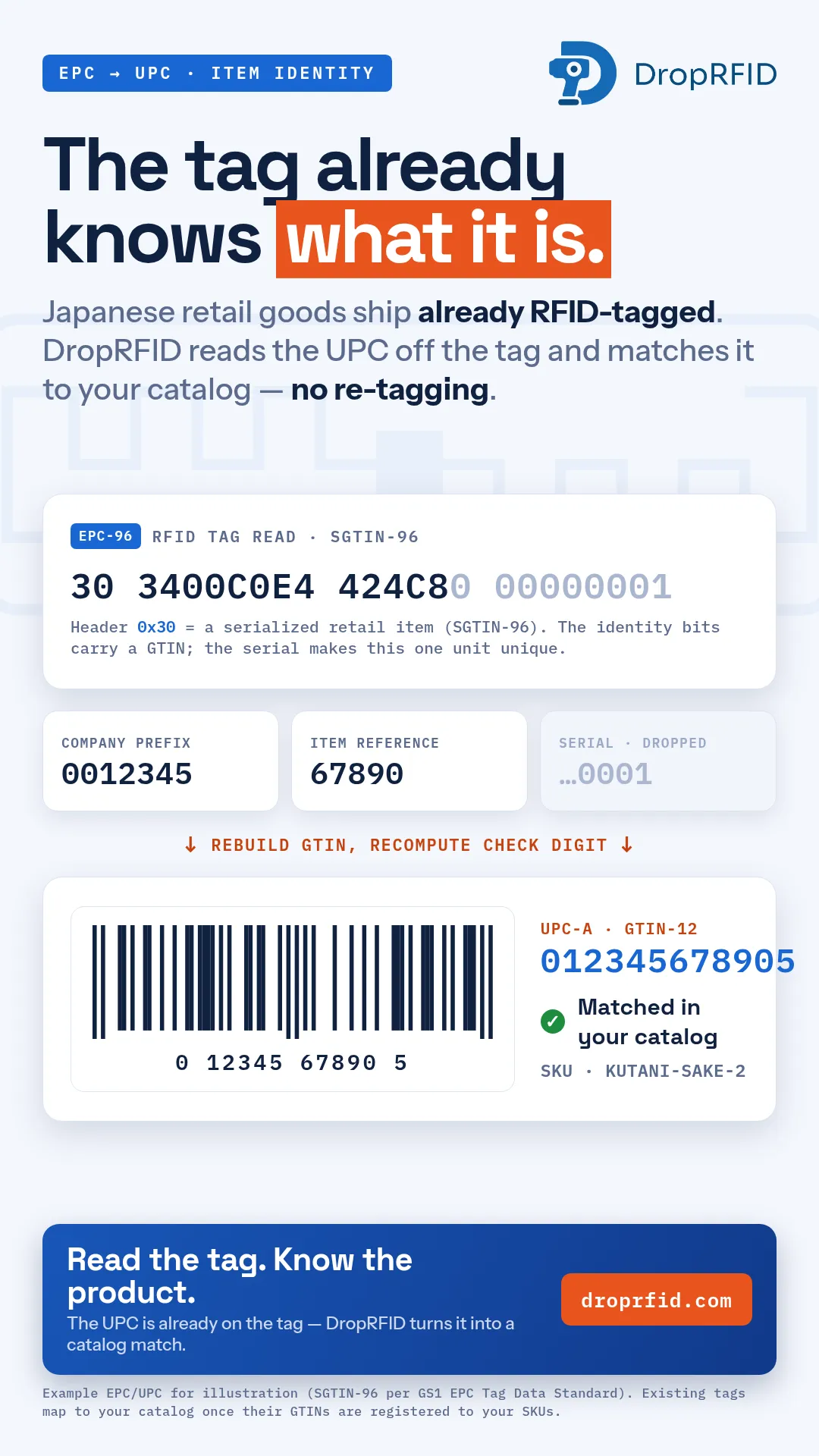
EPC and UPC are different layers
An EPC is a serialized RFID identity. A UPC is a catalog or barcode identity. In a configured workflow, an EPC or tag ID can be associated with the relevant SKU record. The important operational result is not that a tag “knows everything”; it is that the tag identity can resolve to the right product record when the mapping is valid.
That mapping still needs testing. Tag encoding, product packaging, catalog data, and reader conditions all matter. If an item does not resolve, it should become an exception to review rather than an invented match.
Scan against what you ordered
Once the order exists, a receiving session can read the tagged goods and compare the observed set with the expected set. A completed state means the configured comparison found the expected demo identities; it does not prove product quality, authenticity, ownership, or legal provenance.
This distinction matters especially for imported goods. RFID can support a repeatable receiving workflow, but it does not replace customs, purchasing, quality, or supplier controls.
Keep the claim precise
The supplied campaign includes a July 23, 2026 exchange-rate reference. Treat that topical figure as time-bound source material, not a timeless recommendation. The durable lesson is the workflow: create the order, preserve the SKU mapping, scan the arrival, and review exceptions.
If you import products, start with one representative order and test the tag-to-SKU mapping in the actual packaging and read zone. Then review the documentation for order, SKU, and scan workflows.
Document the result as an example receiving procedure: what the operator sees, what counts as matched, and who investigates a missing or unexpected identity. That makes the workflow teachable even when the product mix or supplier changes.
It also gives the team a neutral way to compare suppliers and packaging without turning a temporary market headline into a permanent inventory policy.