Field notes
A clearer way to read an RFID project proposal
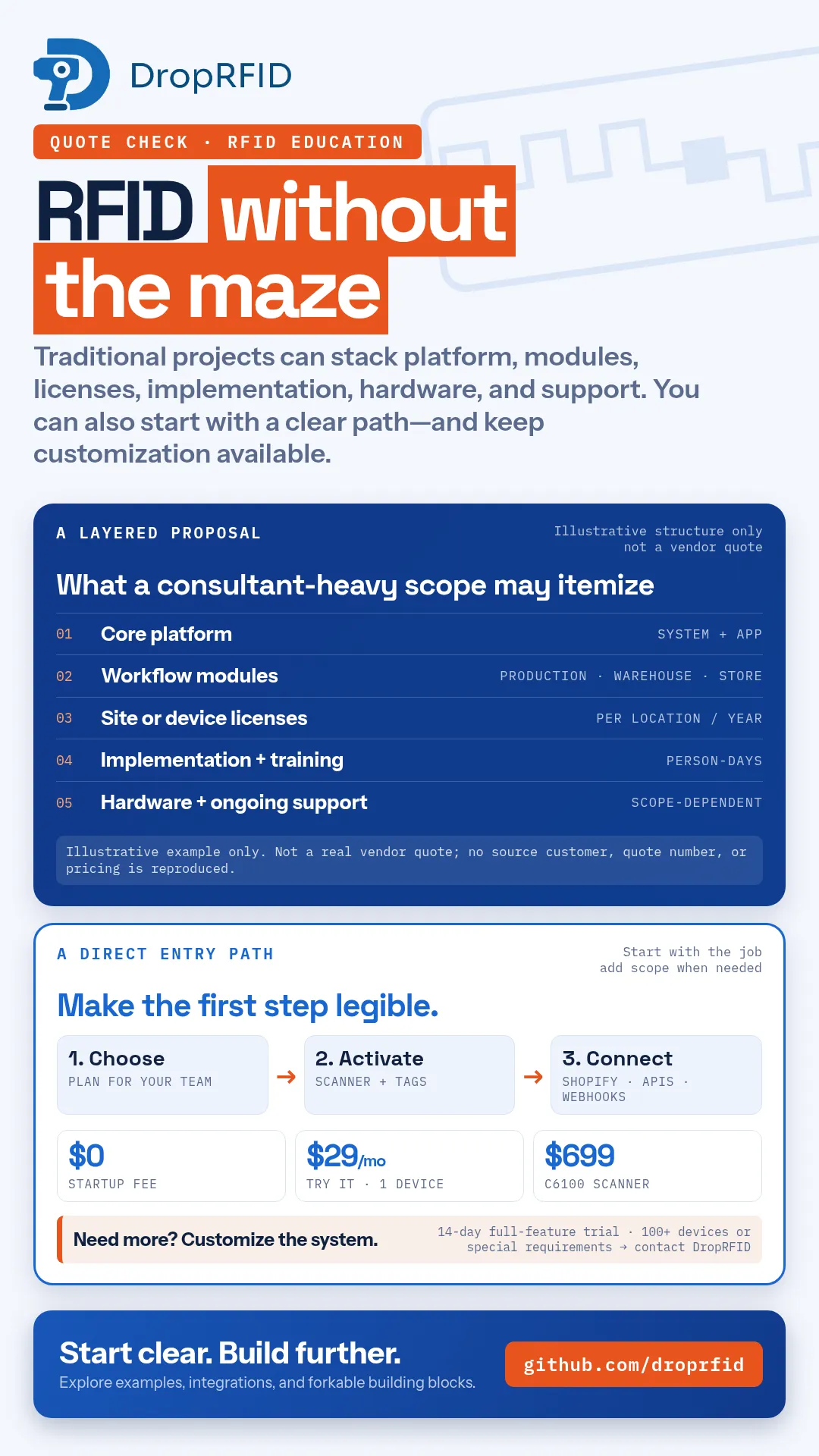
An illustrative breakdown of the cost categories that can appear in a consultant-heavy RFID scope—and a simpler way to plan a first step.
RFID proposals can become difficult to compare when platform fees, workflow modules, licenses, implementation, hardware, and ongoing support all appear as separate lines. Those categories may be reasonable for a large custom deployment, but a long proposal is not automatically a better starting point.
Read the layers before reading the total
An illustrative quote can include a core platform, workflow modules, site or device licenses, implementation and training, hardware, and support. The useful question is not whether every line is “good” or “bad.” It is what each line enables, which items are required now, and which belong to a later phase.
The $45,000 figure shown in the supplied campaign capture is example campaign data. It is not a current DropRFID quote, a universal competitor price, or a verified customer outcome.
Make the first step legible
DropRFID’s published entry path includes a $0 startup fee, a 14-day full-feature trial with no card to start, a Try It plan at $29 per month for one device, and a C6100 scanner priced at $699. These are current reference points, not a promise that every workflow will cost only those amounts. Custom requirements, additional devices, and integration work need their own review.
The purpose of a smaller first step is learning: identify the products, map the RFID identities, create an expected order, and inspect what the reader observes. That gives a team a concrete workflow to evaluate before expanding the scope.
When a larger scope is appropriate
Some organizations need more devices, special requirements, private-cloud or identity controls, dedicated integrations, or an existing WMS/ERP connection. Those needs can justify a broader design and implementation plan. DropRFID’s Custom path is available for 100+ devices or special requirements; configuration-dependent integrations should be described as such.
Questions to ask
- Which product and tag identities must be mapped first?
- What is the expected-versus-observed comparison?
- Which work is setup, and which work repeats monthly?
- Does a downstream system need an after-completion webhook or a designed synchronous integration?
- Which claims are estimates, and which have been measured?
This article is educational and illustrative. It does not reproduce a customer quote or imply affiliation with any vendor shown in the source material. Start with the hardware and plans and validate the scope with the DropRFID team.
The goal is not to make every project look identical. It is to make assumptions visible, so a team can compare a self-serve start with a custom deployment and choose the level of support that matches its actual operating requirements.
That clarity is valuable whether the first project is small or complex: name the expected outcome, the evidence required, and the work that remains conditional.
It also gives reviewers a shared vocabulary for deciding what belongs in a pilot and what belongs in a later phase.