Field notes
From a security label to an item-level RFID workflow
An illustrative Japan retail example shows how tagged items can be connected to expected inventory and scan review.
A small security label can protect an item, but a tag can also carry a usable digital identity. This illustrative Japan retail concept follows the difference between a single-purpose label and an RFID workflow that helps a team track expected items as they are scanned.
The label is only the beginning
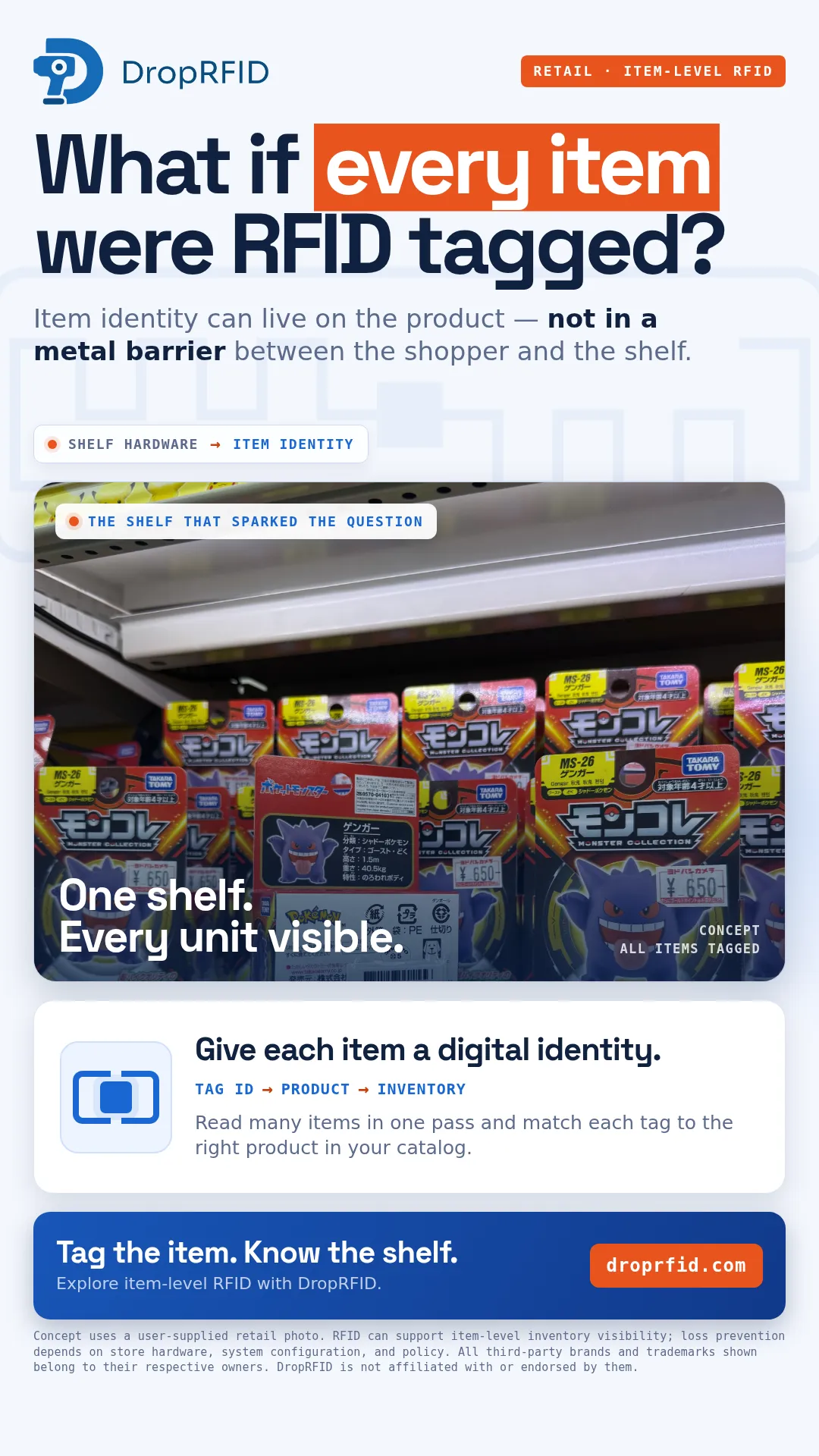
The campaign starts with a store-shelf image and an elevated barcode-style label. It then moves to an example order and a scan session. The story is not a case study of a named store, and it does not claim that DropRFID powers the pictured retail environment. Any retailer, venue, brand, or cultural reference shown in the source remains independent and non-affiliated.
In a real operation, an RFID tag can be mapped to a SKU or item record. A reader captures tag IDs, the system resolves them to products, and a scan session can be compared with the expected order or inventory list. The value is the connection between the physical item and the record the team needs to review.
What the example demonstrates
The sample scan begins at 0/10, progresses through the order, and ends at 10/10 with zero remaining. Those quantities are illustrative. They are not measured customer results, and a completed sample does not prove that every item will be read in every environment.
Read performance depends on tag design, placement, materials, reader settings, interference, and the surrounding environment. A missing read is not automatically evidence of theft or a missing item; it may reflect shielding, detachment, damage, placement, or a tag that was not readable at that moment. Loss-prevention workflows need their own configuration and investigation process.
Build the workflow around the item
DropRFID supports SKU and RFID-to-SKU mapping, scan-session capture, order creation, and expected-versus-scanned review. Shopify paths and connected integrations are available when configured. The current public API does not ingest live RFID reads or complete sessions; avoid presenting it as a universal scanner-control endpoint.
This is an independent educational example, not an endorsement or deployment claim about any Japanese store, brand, or venue. Start with your own tags, operating conditions, and review process at DropRFID.com.
The visual transition from a shelf label to a completed scan is a storytelling shortcut, not a claim that the photographed merchandise was connected to DropRFID. Before publication, review store permissions, identifiable people, logos, prices, and any customer information. If the source shows a real venue or brand, keep the disclosure close to the post so the educational example cannot be mistaken for a customer result. For an actual deployment, use approved synthetic fixtures or cleared customer material and document exactly which items, tags, and conditions were tested. That record keeps an engaging concept separate from evidence that can support an operational decision.