Guides
Custom RFID hardware for your workflow
A concise look at four hardware paths—fixed reader, integrated system, platform scanner, and printer—without assuming a one-size-fits-all deployment.
RFID hardware is most useful when it fits the work around it. A receiving station, a conveyor, a mobile counting route, and a label-printing process may need different physical choices. DropRFID can help scope a custom RFID setup around that workflow.
Four common directions
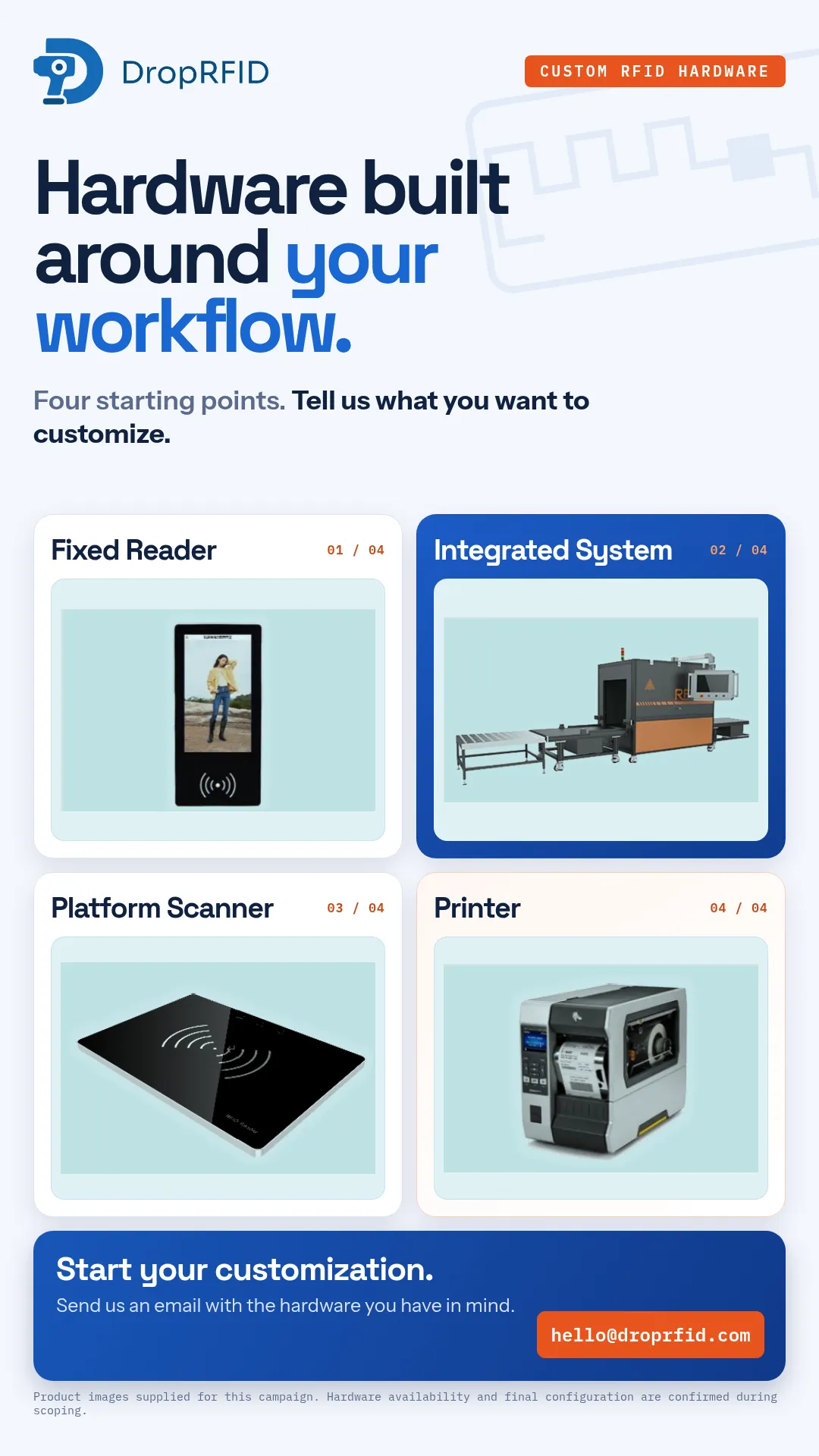
The campaign introduces four hardware categories without attaching unsupported performance claims to them:
- Fixed reader: a reader installed at a defined point in a workflow.
- Integrated system: hardware and software assembled around a specific operational flow.
- Platform scanner: a mobile or mounted scanning platform suited to a repeatable task.
- Printer: equipment for producing labels or tags as part of a configured process.
These labels describe possible directions, not a promise that every category is stocked, interchangeable, or appropriate for every environment. Final availability, configuration, quantities, installation, and third-party requirements are confirmed during scoping.
Start with the operation
Before choosing hardware, describe what must be identified, where items move, what materials surround the tag, and what the system should do with the result. A fixed reader may suit a controlled doorway or station. A handheld reader may be better for flexible counts. A printer may matter when the operation creates or replaces labels. The right answer depends on the work and the read environment.
DropRFID’s platform supports RFID session capture and review, SKU and tag mapping, order comparison, and connected workflows through documented APIs and signed webhooks when configured. Hardware integration is not the same as an automatic full-system replacement; WMS, ERP, BI, and custom software connections require their own scope.
Scope a responsible rollout
Start with a small, representative test. Measure the intended tags and materials, document placement, account for interference, and define how a mismatch will be reviewed. Then confirm the hardware list, setup, software integration, onboarding, and launch support in an approved proposal.
For custom requirements, contact DropRFID at hello@droprfid.com. The campaign’s product names are illustrative, and public-use rights for supplied hardware images should be confirmed before publication.
Good scoping also separates what is known from what still needs testing. Document the desired read zone, throughput requirement, tag materials, mounting constraints, power and network conditions, and the system that owns the resulting records. Include an exception path for unreadable or unexpected tags. A proposal can then identify the hardware, software work, integration boundaries, onboarding, and support assumptions clearly. That is safer than treating a single photograph or category label as a finished architecture. The goal is a documented fit between equipment, data, people, and the physical environment.
It also gives the team a shared reference for future changes and maintenance.
That shared reference is often as important as the equipment list itself.
It helps keep procurement, implementation, and operations aligned during rollout.