Guides
Meet the C6100 handheld RFID reader
A qualified overview of the Android C6100 handheld reader, its canonical specifications, and where range depends on the environment.
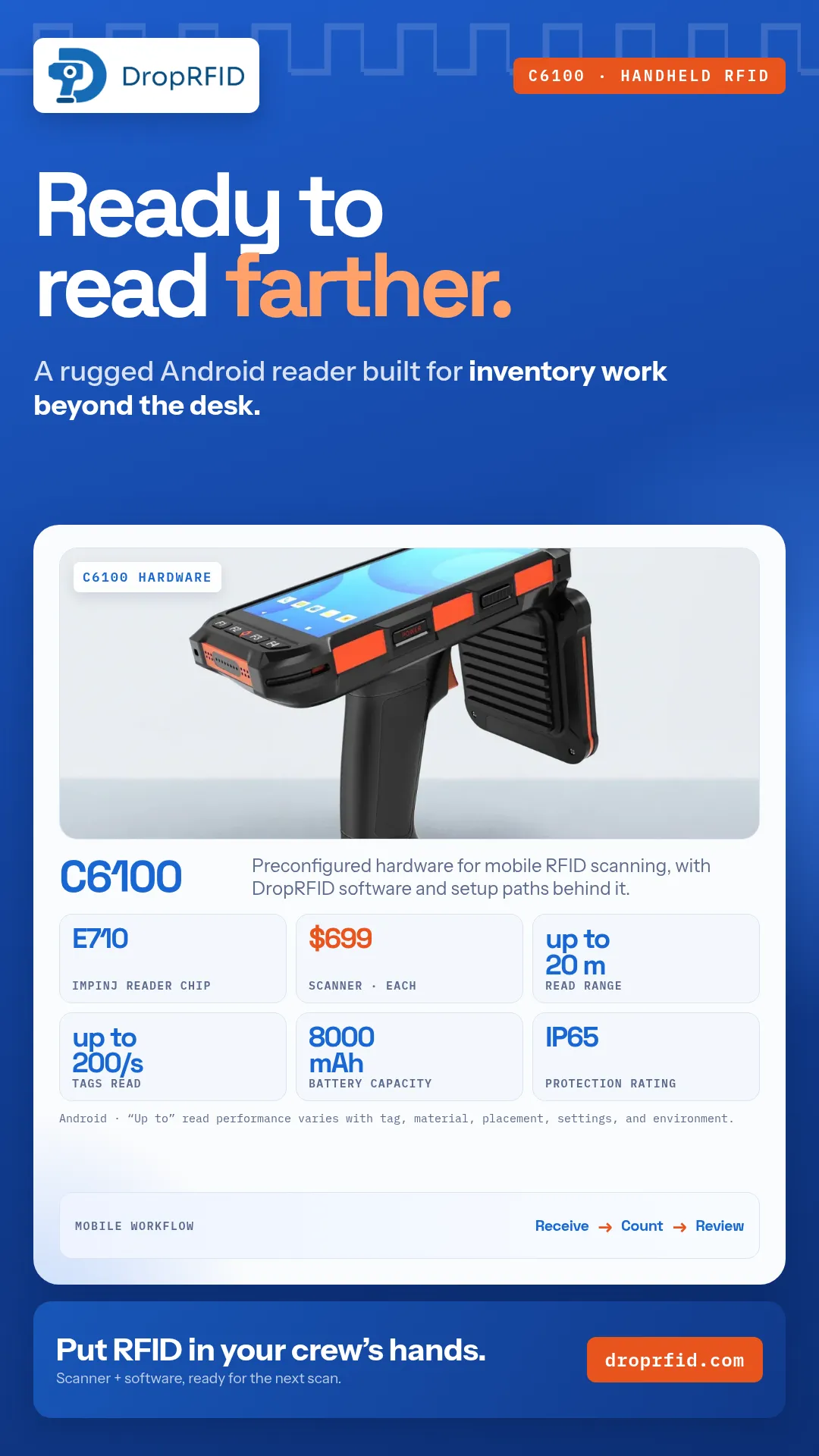
RFID work does not always happen at a desk. The C6100 puts a handheld Android reader into the flow of inventory work, where an operator can move through a receiving area, stockroom, or counting task and review a scan session as it progresses.
Canonical hardware details
The C6100 uses an Impinj E710 reader and has IP65 protection. Its battery capacity is 8000 mAh. Qualified performance is up to 20 metres and up to 200 tags per second, depending on the tags, materials, placement, reader settings, interference, and environment. These are “up to” figures, not guarantees for every deployment.
The canonical price is $699 each. A Starter Kit is listed separately at $720 and includes a scanner, a 200-pack of RFID tags, and a charging base. Hardware is purchased through the direct DropRFID Shopify checkout, not Amazon.
Put the reader into a workflow
A handheld reader becomes useful when its reads have operational context. DropRFID can capture a scan session, map RFID identifiers to SKUs, and compare observed items with an expected order. Teams can use that pattern for inventory scans, receiving, order verification, and related review workflows.
The scan-session footage in this campaign is a demonstration clip played back at accelerated picture speed. It is not a measured field test, and it does not establish a fixed scan rate or accuracy result. Validate the reader with the tags and materials you intend to use before relying on a range or throughput assumption.
Choose the setup that fits
The C6100 is one path into RFID work. A 14-day trial provides full feature access and begins after first scanner activation; no card is required to start. DropRFID also offers Business and Enterprise plans, while custom requirements for 100 or more devices can be scoped with the team.
For a grounded rollout, start with the physical task, define the expected data, test read conditions, and decide how exceptions will be reviewed. Put RFID in your crew’s hands at DropRFID.com.
The physical specification is only one part of a buying decision. Consider charging, carry method, operator training, label supply, network access, and how a completed session reaches the next system. Decide which tasks need a handheld and which are better served by a fixed reader or another custom configuration. Then run a representative pilot with the actual tag stock and materials. That process turns a headline specification into a deployment decision grounded in the work your team performs. Record the test conditions with the result, since a range observed with one label and surface should not be generalized to every item in the catalog.
The record can include operator movement, scan duration, and exception handling.
Those notes make later troubleshooting more concrete and keep “up to” language tied to evidence.