Field notes
Match the right items. Verify the quantity.
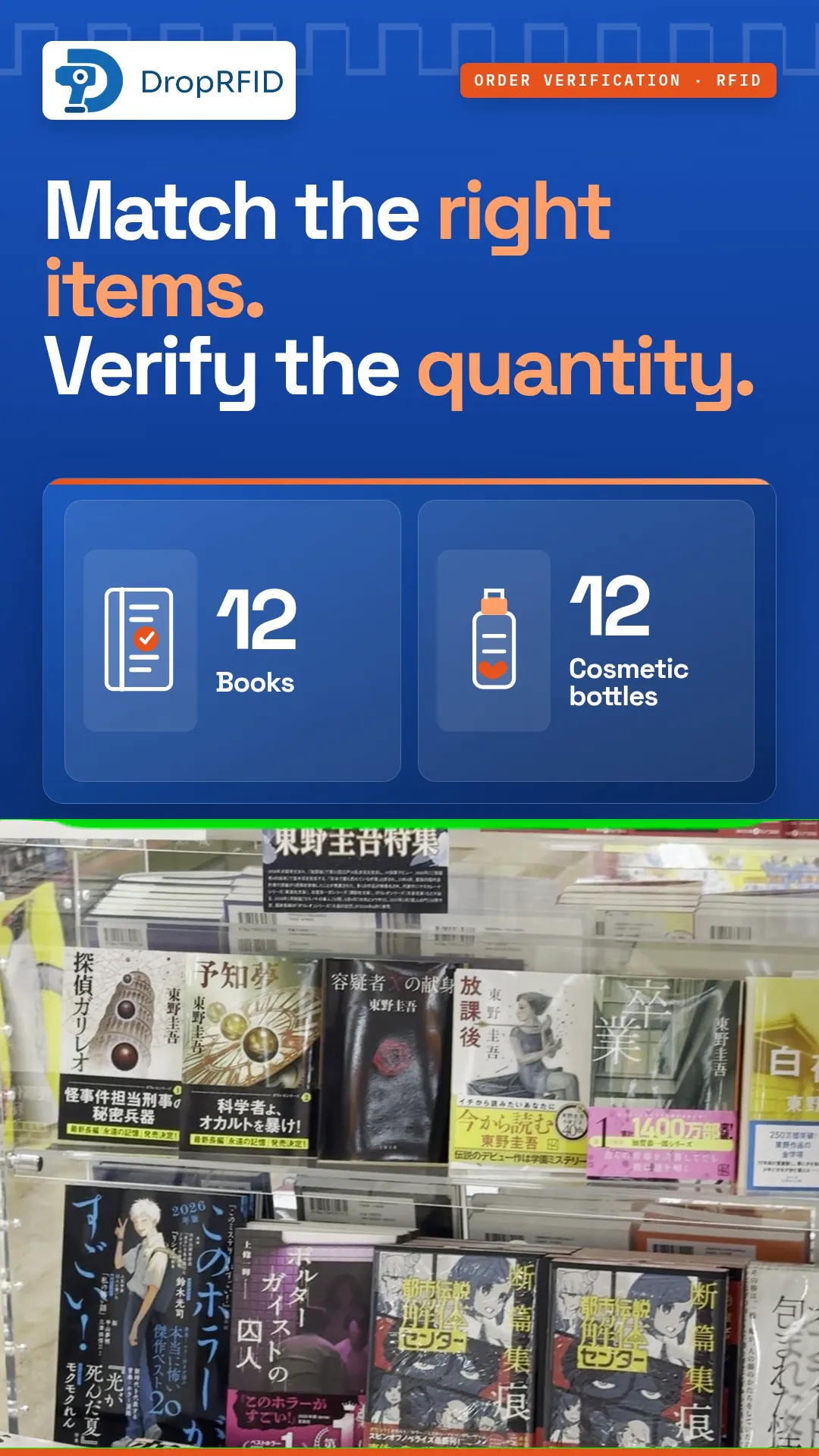
An illustrative bookstore workflow pairs an expected order with RFID scan review for bundled magazine and cosmetic items.
Some bookstore magazines come with something extra: a related cosmetic item sealed inside the package. That creates a practical verification question. How can staff check that the right item and quantity are present when direct line of sight is limited?
This campaign uses an illustrative workflow. The sample order expects 12 magazine units and 12 matching cosmetic bottles—24 expected items in two lines. The values and product data are synthetic, not a report from a bookstore, publisher, author, or cosmetics brand.
Create the expected order
The first step is to define what should be present. In DropRFID, a team can create an order with the relevant SKUs and quantities, then map RFID tag IDs to the products. For this example, the order contains one book SKU and one matching bottle SKU, each with an expected quantity of 12.
Keeping the two lines explicit is important. Twelve paired packages are not automatically the same thing as a data model containing 12 magazines and 12 bottles. The expected structure should match the way the operation counts and reviews physical items.
Scan, compare, review
The demonstration moves from 0/12 to 6/12 and then 12/12 for both lines. That progression is rendered sample data. In a real workflow, a scan session captures observed tag IDs and resolves them to mapped SKUs. The team can then compare observed items and quantities with the order and review any mismatch.
RFID can support item lifecycle tracking, order verification, and loss-prevention or missing-item investigations depending on the tags, read environment, and system configuration. A missing RFID read is not proof of theft or proof that a physical item is absent; it may reflect placement, shielding, detachment, damage, or an unreadable tag.
Keep the example honest
The footage should be cleared before publication for store signage, staff, faces, magazine covers, brands, prices, and customer information. The visual is an educational concept, not a bookstore case study. No bookstore, publisher, magazine, author, or cosmetics brand is affiliated with or endorsing DropRFID unless separately stated.
The operational idea is simple: define the expected items, scan the tagged units, compare the result, and investigate exceptions. Learn more about order verification and RFID workflows at DropRFID.com.
The same pattern can apply beyond magazines. Any operation that handles expected item sets can define the list first, map the physical tags, and compare the observed session afterward. That does not mean every bundle needs a special parent-child data model, nor does it eliminate human review. It gives staff a structured checkpoint. If a line is short, they can inspect placement, packing, tag condition, or the source order before deciding what happened. The result is a clearer investigation trail than relying on memory or a visual count alone.