Field notes
What does up to 20 metres of RFID range mean?
An illustrative Beppu Ropeway comparison explains why a local read range is not the same as a distant scan.
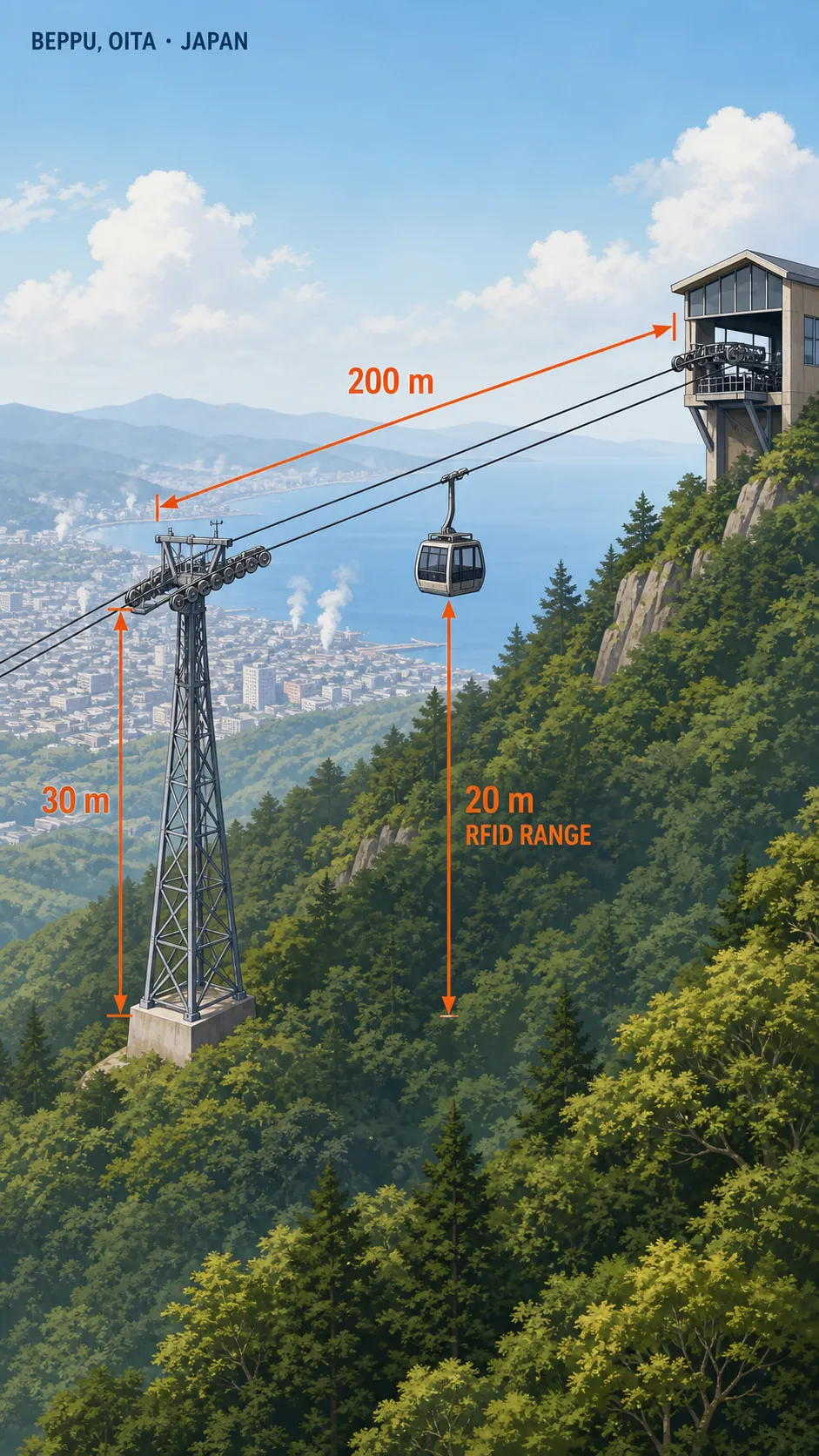
The Beppu Ropeway’s climb up Mount Tsurumi is a striking way to think about distance. But a handheld RFID scanner is not intended to read an item at a faraway station. The useful comparison is local: the C6100 is rated for up to 20 metres under suitable conditions.
Local range, not a remote scan
The campaign illustration draws a short distance from a hanging cabin toward nearby treetops. It is an educational scale comparison, not a surveyed cabin-to-tree distance and not a demonstration of a successful scan. Beppu Ropeway is not affiliated with, connected to, or endorsing DropRFID, and no ropeway infrastructure is shown as tagged.
“Up to” matters. RFID performance depends on the tag, orientation, mounting material, reader settings, interference, terrain, vegetation, environment, and applicable radio rules. A nominal maximum is not a promise that every tag will read at that distance in every location.
Put the range in an operating context
For receiving, cycle counts, order verification, or other inventory work, the question is usually not “Can the reader reach the next landmark?” It is “Does the read zone cover the work area with the tags and materials we actually use?” That answer requires a test with the intended scanner, tags, placement, and environment.
The C6100 combines an Android handheld form factor with an Impinj E710 reader and a qualified range of up to 20 metres. Teams should validate the result in their own workflow, account for interference, and define how exceptions will be reviewed.
A grounded takeaway
The ropeway story makes a simple distinction memorable: a long track does not mean a handheld reader scans end to end. A serious local range can still be useful when it is matched to the task and verified in context.
This is an independent educational concept, not a Beppu Ropeway case study or endorsement. Explore the C6100 and start a 14-day free trial at DropRFID.com.
The scenery is useful precisely because it makes an unreasonable interpretation obvious. A handheld device should not be presented as a remote sensing system that reaches across a mountain view. Instead, use the landscape to ask a local planning question: how large is the work zone, and can the operator move through it while tags remain readable? A site test can record the tag type, orientation, distance, surface, reader power settings, and interference conditions. That evidence is more useful than a dramatic but unqualified distance claim. A repeatable site test gives operators a baseline when tags, fixtures, or the layout change.
That baseline helps distinguish a changed environment from a changed application result.
Use the findings to set expectations with operators before the first production count.
It is a practical safeguard against turning a headline number into a promise.